Bible Reference > Bible Facts > Biblical Words and Phrases > INRI
By Rev. Jason Elder · Updated November 27, 2026
Introduction
INRI stands for the Latin words Iesus Nazarenus Rex Iudaeorum, which means "Jesus of Nazareth, the King of the Jews." It is the abbreviation of the sign Pontius Pilate had placed above Jesus' head on the cross. John's Gospel says the sign was written in Hebrew, Latin, and Greek (John 19:19–20). INRI comes from the Latin version, and it is why so many crucifixes and paintings of the crucifixion show those four letters at the top of the cross.
I didn't grow up going to church. But I remember flipping through a large family Bible, the kind filled with pictures. I was fascinated by the stories and the images. I remember seeing Jesus teaching on a mountainside. I remember Jesus standing in front of someone, who I later learned was Pilate. And I remember Jesus on the cross, with four strange letters placed over his head: INRI.
If you've ever looked at a crucifix, a painting, or an old family Bible and wondered what those letters mean, you're not alone. Let's answer the question.
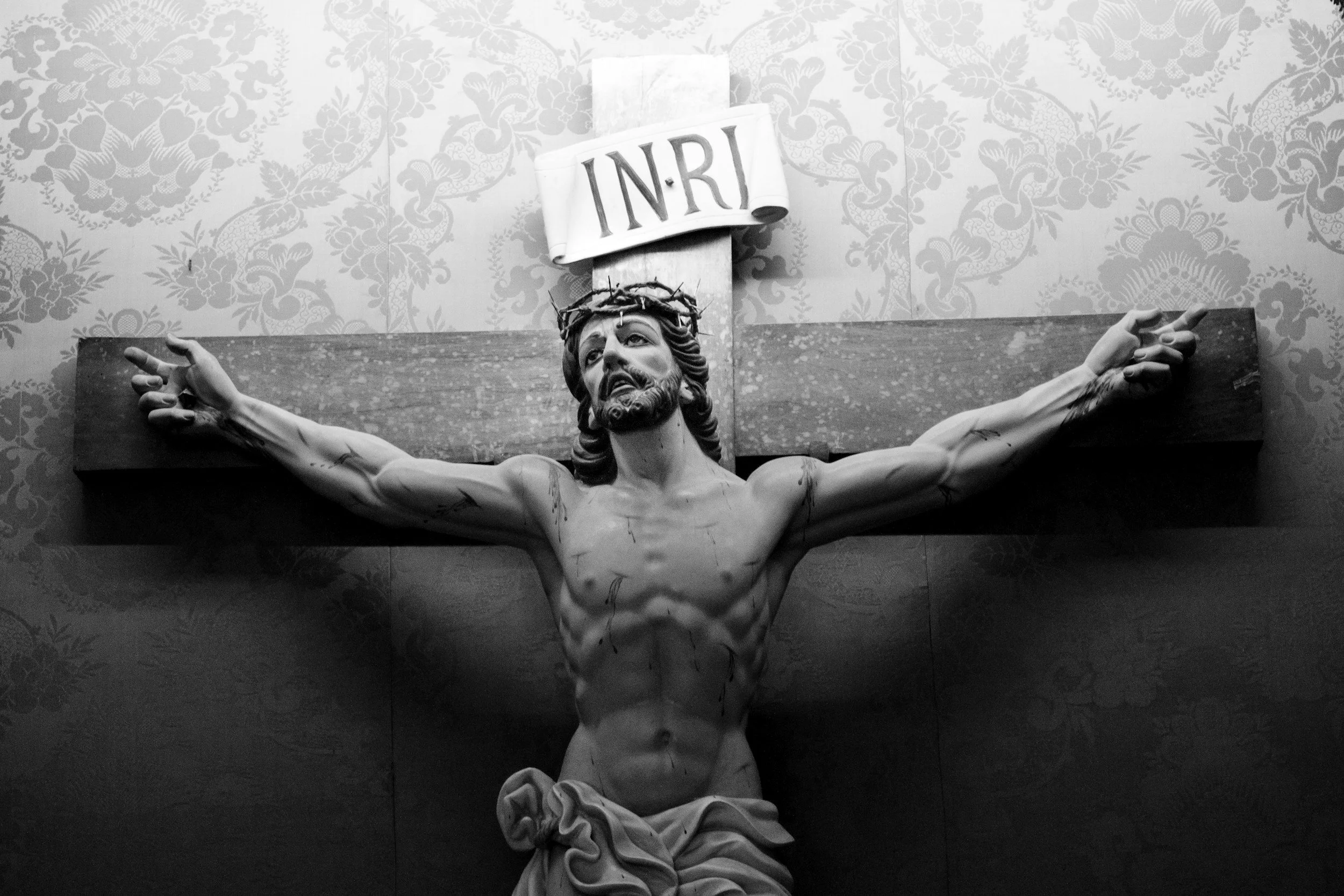
Often on crucifixes, the letters INRI are affixed above Jesus’ head. The letters are an acronym. I (Jesus), N (Nazarenus), R (Rex), I (Iudaeorum), which in English is “Jesus of Nazareth, the King of the Jews.
INRI: Quick Facts
| INRI Stands For | Iesus Nazarenus Rex Iudaeorum |
|---|---|
| English | "Jesus of Nazareth, the King of the Jews" |
| Language | Latin (the sign was also in Hebrew and Greek) |
| Written By | Pontius Pilate's order (John 19:19) |
| In the Bible | Matthew 27:37; Mark 15:26; Luke 23:38; John 19:19–22 |
| Greek Form | INBI, used on Orthodox crosses and icons |
| Why It Was There | The Roman titulus, a placard announcing the charge |
What Does INRI Stand For?
INRI is an acronym, the first letter of each of four Latin words:
Put together, Iesus Nazarenus Rex Iudaeorum means "Jesus the Nazarene, King of the Jews," or as most English Bibles put it, "Jesus of Nazareth, the King of the Jews" (John 19:19).
Why an "I" and not a "J"? Latin had no letter J. The sound was written with an I, so Iesus (Jesus) and Iudaeorum (of the Jews) both begin with I. The letter J developed much later.
| Letter | Latin Word | English |
|---|---|---|
| I | Iesus | Jesus |
| N | Nazarenus | the Nazarene (of Nazareth) |
| R | Rex | King |
| I | Iudaeorum | of the Jews |
The Sign in Three Languages
John is the Gospel writer who tells us the most about the sign:
Pilate also had an inscription written and put on the cross. It read, "Jesus of Nazareth, the King of the Jews." Many of the Jews read this inscription, because the place where Jesus was crucified was near the city; and it was written in Hebrew, in Latin, and in Greek. (John 19:19–20)
Each language had its own audience.
Hebrew (probably Aramaic, the everyday language of Judea, which John calls "Hebrew") was for the local people.
Latin was the official language of Rome, the language of law and government.
Greek was the common language of the eastern Roman Empire, understood by travelers and pilgrims from everywhere.
So the sign spoke to the whole world that passed by. Without intending it, Pilate announced Jesus' kingship in the languages of religion, government, and culture.
INRI in Hebrew
In Hebrew the title would be Yeshua HaNotzri uMelech HaYehudim. Some Christians have pointed out that the first letters of those words in Hebrew (Yod, He, Vav, He) spell YHWH, the sacred name of God. It's a striking devotional observation, but the Gospels don't mention it, and we don't know the exact wording of the Hebrew or Aramaic sign.
INRI in Greek
In Greek the title reads Iēsous ho Nazōraios ho Basileus tōn Ioudaiōn. Eastern Orthodox icons often abbreviate it as INBI, from the Greek letters. Many Orthodox icons instead read "The King of Glory," a title drawn from Psalm 24:7–10.
The Sign in the Four Gospels
All four Gospels mention the sign, and each words it a little differently.
The differences are small, and they make sense if the sign appeared in three languages and each writer gave its gist. The core is the same in all four: "the King of the Jews." That was the official charge. It was the crime for which Rome executed Jesus. See Jesus Before Pilate and Herod (Luke 23:1–12).
| Gospel | Wording of the Sign |
|---|---|
| Matthew 27:37 | "This is Jesus, the King of the Jews." |
| Mark 15:26 | "The King of the Jews." |
| Luke 23:38 | "This is the King of the Jews." |
| John 19:19 | "Jesus of Nazareth, the King of the Jews." (in Hebrew, Latin, and Greek) |
Why Was There a Sign on the Cross?
The Romans often announced the crime of a condemned prisoner on a placard, called a titulus in Latin. It might be carried in front of the prisoner on the way to execution or hung around his neck, and it could be fastened to the cross. Roman writers describe the practice. The point was public warning: this is what happens to people who do this.
For Jesus, the charge was "King of the Jews." To Rome, claiming to be a king without the emperor's permission was treason. Pilate had asked Jesus, "Are you the King of the Jews?" (John 18:33), and the chief priests had warned Pilate, "Everyone who claims to be a king sets himself against the emperor" (19:12).
But Pilate seems to have meant the sign as more than a warning. It was also an insult to the leaders who had pressured him. The message was: here is your king, on a Roman cross.
"What I Have Written I Have Written"
The chief priests understood the insult. John tells us what happened next:
Then the chief priests of the Jews said to Pilate, "Do not write, 'The King of the Jews,' but, 'This man said, I am King of the Jews.'" Pilate answered, "What I have written I have written." (John 19:21–22)
They wanted the sign to describe a false claim. Pilate refused to change a word. After giving in to them on everything else that morning, this is the one place he stood firm.
And here is the irony John wants us to see. Pilate meant it as mockery. The priests saw it as an insult. But the sign told the truth. Jesus is the King. The Magi had come looking for "the child who has been born king of the Jews" (Matthew 2:2). At the end, a Roman governor nailed the same title above his head. See Pontius Pilate: Who He Was, Why He Crucified Jesus, and What Happened Next.
Why Is INRI on Crucifixes?
Western Christianity used the Latin Bible for more than a thousand years. Artists and craftsmen naturally used the Latin wording of the sign, and to fit it on a small plaque at the top of a cross they shortened it to its initials. That is why INRI appears on crucifixes in Catholic churches, on Lutheran and Anglican altar crosses, in medieval and Renaissance paintings, and in old family Bibles.
In Eastern Orthodox churches, crosses and icons often use Greek letters instead, either INBI or the words "King of Glory."
The Titulus Crucis
In Rome, the Basilica of the Holy Cross in Jerusalem (Santa Croce in Gerusalemme) displays a worn piece of wood with fragments of an inscription in Hebrew, Greek, and Latin. Tradition says it is part of the original sign, brought to Rome by Helena, the mother of Constantine. A radiocarbon test published in 2002 dated the wood to around the 10th to 12th centuries, so most scholars consider it a medieval relic rather than the actual sign.
What INRI Means for Us
When I think back to that family Bible, I'm struck by how much those four letters were preaching to me before I could understand them. A picture of a dying man, and above him, the words "King of the Jews."
The cross is a throne. Everyone around the cross thought Jesus' kingship was a joke. The soldiers mocked him: "If you are the King of the Jews, save yourself!" (Luke 23:37). But John and the other Gospel writers want us to see that Jesus reigned precisely by giving himself up. His crown was thorns, and his throne was a cross. See The Crucifixion of Jesus (Luke 23:33–43).
His kingdom is for the whole world. The sign was written in three languages so that everyone could read it. From the beginning, the cross was meant for all people. As Jesus said, "when I am lifted up from the earth, I will draw all people to myself" (John 12:32).
God can use even mockery to tell the truth. Pilate didn't believe a word of the sign. Yet two thousand years later, it still announces who Jesus is. That's one of my favorite things about God. He keeps turning our worst intentions into his best news.
Frequently Asked Questions About INRI
What does INRI mean on the crucifix?
INRI stands for Iesus Nazarenus Rex Iudaeorum, Latin for "Jesus of Nazareth, the King of the Jews." It abbreviates the sign Pilate had placed on Jesus' cross (John 19:19).
What does INRI stand for in English?
"Jesus of Nazareth, King of the Jews." Word by word: I = Jesus, N = of Nazareth (the Nazarene), R = King, I = of the Jews.
What does INRI mean in Hebrew?
INRI itself is Latin. The Hebrew form of the title would be Yeshua HaNotzri uMelech HaYehudim, "Jesus the Nazarene and King of the Jews."
Is INRI in the Bible?
The letters INRI aren't in the Bible, but the words they stand for are. John 19:19 records the inscription "Jesus of Nazareth, the King of the Jews," and the other Gospels give shorter forms (Matthew 27:37; Mark 15:26; Luke 23:38).
Why was "King of the Jews" written on the cross?
It was the official charge against Jesus. Claiming to be a king was treason against Rome. Pilate also used the sign to mock the leaders who had pressured him into the execution.
Is INRI Catholic?
INRI is most familiar from Catholic crucifixes, but it isn't only Catholic. It comes from the Latin Bible used throughout Western Christianity and appears on Lutheran, Anglican, and other crosses too. Orthodox churches usually use the Greek form, INBI.
Why does INRI use an I instead of a J?
Classical Latin had no letter J. The names we spell with a J, like Jesus and Judea, were written with an I.
What does INBI mean?
INBI is the Greek equivalent of INRI, from Iēsous ho Nazōraios ho Basileus tōn Ioudaiōn, "Jesus the Nazarene, the King of the Jews." It appears on many Eastern Orthodox crosses and icons.
Related Reading
Scripture quotations are from the New Revised Standard Version Bible, copyright © 1989 the National Council of the Churches of Christ in the United States of America. Used by permission. All rights reserved worldwide.
Works Consulted
Bella, Francesco, and Carlo Azzi. "14C Dating of the 'Titulus Crucis.'" Radiocarbon 44, no. 3 (2002): 685–689.
Brown, Raymond E. The Death of the Messiah. 2 vols. Anchor Bible Reference Library. New York: Doubleday, 1994.
Carson, D. A. The Gospel According to John. Pillar New Testament Commentary. Grand Rapids: Eerdmans, 1991.
Hengel, Martin. Crucifixion in the Ancient World and the Folly of the Message of the Cross. Philadelphia: Fortress, 1977.
Keener, Craig S. The Gospel of John: A Commentary. 2 vols. Peabody, MA: Hendrickson, 2003.