What is Hezekiah’s Tunnel?
Quick Summary
Hezekiah’s Tunnel is an ancient water tunnel carved beneath Jerusalem in the late eighth century BCE. Built during the reign of King Hezekiah, it redirected water from the Gihon Spring to the Pool of Siloam to protect the city during an Assyrian siege. Both the Bible and archaeology remember it as a remarkable intersection of faith, fear, and engineering.
Introduction
Hezekiah’s Tunnel stands at the intersection of Scripture, archaeology, and lived human anxiety. It was not built in a moment of triumph but in a season of threat. Jerusalem was facing the expanding Assyrian Empire, a military machine that had already destroyed the northern kingdom of Israel. In that moment, King Hezekiah made a practical and deeply theological decision: if the city was to survive, its water source needed to be secured.
Unlike monumental temples or royal palaces, Hezekiah’s Tunnel is hidden underground. Its significance lies not in what it displays, but in what it preserves. Water meant life. Cutting off access to water was a common siege tactic. By rerouting the Gihon Spring into the city walls, Hezekiah acted to protect Jerusalem’s most vulnerable point.
This tunnel matters because it is one of the clearest places where the Bible’s historical claims can be tested against physical evidence. Scripture describes the project. Archaeology confirms it. And theology reflects on what it means when faith responds to danger with preparation rather than denial.
What Is Hezekiah’s Tunnel?
Hezekiah’s Tunnel, also called the Siloam Tunnel, is an underground passage approximately 1,750 feet long carved through solid limestone beneath the City of David in Jerusalem. It connects the Gihon Spring, Jerusalem’s primary natural water source, to the Pool of Siloam inside the city.
What makes the tunnel extraordinary is not only its length, but its construction. Two teams began digging from opposite ends and met in the middle, a feat described both in Scripture and in an ancient inscription discovered inside the tunnel. The passage follows a winding, S-shaped route, suggesting adjustments made as workers followed sound or natural fissures in the rock.
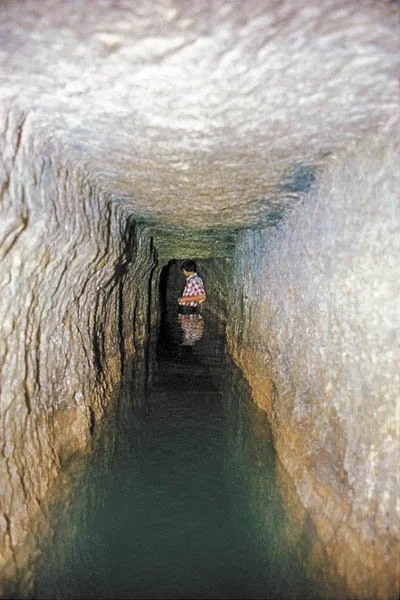
The tunnel still carries water today. Visitors can walk its length, often wading through ankle- to knee-deep water, experiencing the same dark, narrow space that ancient Jerusalemites relied upon for survival.
Source: Biblical Archeology Society
The tunnel still carries water today. Visitors can walk its length, often wading through ankle- to knee-deep water, experiencing the same dark, narrow space that ancient Jerusalemites relied upon for survival.
Hezekiah’s Tunnel in the Bible
The Bible refers to Hezekiah’s water project explicitly. Second Kings 20:20 records, “Now the rest of the deeds of Hezekiah, all his might, and how he made the pool and the conduit and brought water into the city, are they not written in the Book of the Annals of the Kings of Judah?”
Second Chronicles 32 provides further context. As the Assyrians advanced, Hezekiah “blocked the upper outlets of the springs and directed them down to the west side of the city of David” (2 Chronicles 32:30). The text presents this act not as a lack of faith, but as wise leadership.
Hezekiah prayed fervently for deliverance, yet he also prepared strategically. The Bible does not place these actions in tension. Prayer and planning are shown working together. Trust in God does not negate responsibility; it sharpens it.
Historical and Archaeological Evidence
In 1880, archaeologists discovered the Siloam Inscription carved into the tunnel wall. Written in ancient Hebrew, it describes the moment when the two digging teams met. The inscription recounts hearing voices through the rock and breaking through until water flowed freely.
This inscription is one of the oldest known Hebrew texts ever found and provides rare confirmation of a biblical event from within its own historical context. Today, the inscription is housed in the Istanbul Archaeology Museums.
Archaeological dating places the tunnel firmly in the late eighth century BCE, aligning with the reign of King Hezekiah and the Assyrian campaigns under Sennacherib. Few biblical narratives enjoy this level of convergence between text and terrain.
Why Was Hezekiah’s Tunnel Necessary?
Jerusalem’s geography made it both defensible and vulnerable. The city sat high on a ridge, protected by steep valleys, but its main water source lay outside the walls. In peacetime, this was manageable. In wartime, it was deadly.
Assyrian strategy often involved laying siege until cities collapsed from hunger and thirst. By diverting the Gihon Spring into the city, Hezekiah denied the enemy access to water while ensuring supply for Jerusalem’s inhabitants.
This decision reflects a theology grounded in realism. Hezekiah did not assume that faith would make preparation unnecessary. Instead, faith informed preparation. The tunnel embodies a biblical ethic that takes threat seriously without surrendering hope.
Engineering and Human Ingenuity
The tunnel’s irregular path has fascinated engineers and historians alike. Unlike Roman aqueducts, which follow straight lines and precise gradients, Hezekiah’s Tunnel curves dramatically. Scholars debate whether the builders followed sound vibrations, natural cracks in the rock, or a combination of both.
What is clear is that the project required coordination, skill, and courage. Workers carved through rock with hand tools in total darkness, guided by limited information. The tunnel is not just a royal achievement; it is a testament to collective labor under pressure.
Theological Meaning of Water in This Story
Water in the Bible consistently symbolizes life, provision, and divine care. By securing water, Hezekiah was not only protecting physical survival but preserving the conditions necessary for worship, community, and covenant life.
Later in the Gospel of John, Jesus heals a blind man at the Pool of Siloam (John 9). The same water system built centuries earlier becomes the setting for a sign pointing to spiritual sight and renewal. The tunnel’s purpose expands beyond survival into the realm of revelation.
Faith, Fear, and Preparation
Hezekiah’s Tunnel challenges simplistic ideas about faith. The biblical narrative does not portray preparation as a lack of trust. Instead, it frames wise action as an expression of faith.
Second Chronicles 32 holds together two truths: Hezekiah fortified the city, and he prayed. The tunnel stands as a reminder that faith often looks like quiet, unseen work done in anticipation of danger.
Why Hezekiah’s Tunnel Still Matters
Today, Hezekiah’s Tunnel matters because it grounds Scripture in real places and real decisions. It shows that biblical faith was lived out in political, military, and ecological realities.
The tunnel also invites reflection on leadership. Hezekiah did not build monuments to his own glory. He invested in infrastructure that served the common good. His legacy flows not from spectacle, but from provision.
FAQ
What is Hezekiah’s Tunnel also called?
It is commonly known as the Siloam Tunnel because it carries water to the Pool of Siloam.
How long is Hezekiah’s Tunnel?
The tunnel is approximately 1,750 feet long.
Is Hezekiah’s Tunnel mentioned directly in the Bible?
Yes. It is referenced in 2 Kings 20:20 and described more fully in 2 Chronicles 32:30.
Can people still walk through Hezekiah’s Tunnel today?
Yes. It is open to visitors in Jerusalem and still carries flowing water.
Works Consulted
The New Revised Standard Version of the Bible.
K. A. Kitchen, On the Reliability of the Old Testament.
Israel Finkelstein and Neil Asher Silberman, The Bible Unearthed.
James K. Hoffmeier, The Archaeology of the Bible.
