What Is the Garden of Gethsemane?
Quick Answer
The Garden of Gethsemane is an olive grove on the lower slope of the Mount of Olives, just across the Kidron Valley from Jerusalem. On the night before his crucifixion, after the Last Supper, Jesus went there to pray. He asked the Father, "Remove this cup from me; yet, not what I want, but what you want" (Mark 14:36). His disciples fell asleep, Judas arrived with an armed crowd, and Jesus was arrested.
The name Gethsemane means "oil press." It was a place where olives were crushed for their oil, and it became the place where Jesus was pressed to the limit and still chose his Father's will.
Gethsemane at a Glance
| Name | Gethsemane, from Aramaic gat shemanim, "oil press" |
| Where | Western slope of the Mount of Olives, east of Jerusalem across the Kidron Valley |
| Bible passages | Matthew 26:36–56; Mark 14:32–52; Luke 22:39–53; John 18:1–12 |
| When | Thursday night of Holy Week, after the Last Supper at Passover |
| Who was there | Jesus, the eleven disciples (Peter, James, and John nearest), then Judas with an armed crowd |
| What happened | Jesus prayed in anguish, the disciples slept, Judas betrayed him with a kiss, and Jesus was arrested |
| Key verse | "Abba, Father, for you all things are possible; remove this cup from me; yet, not what I want, but what you want." (Mark 14:36) |
| Today | The Church of All Nations and an olive grove with some of the oldest olive trees in the world |
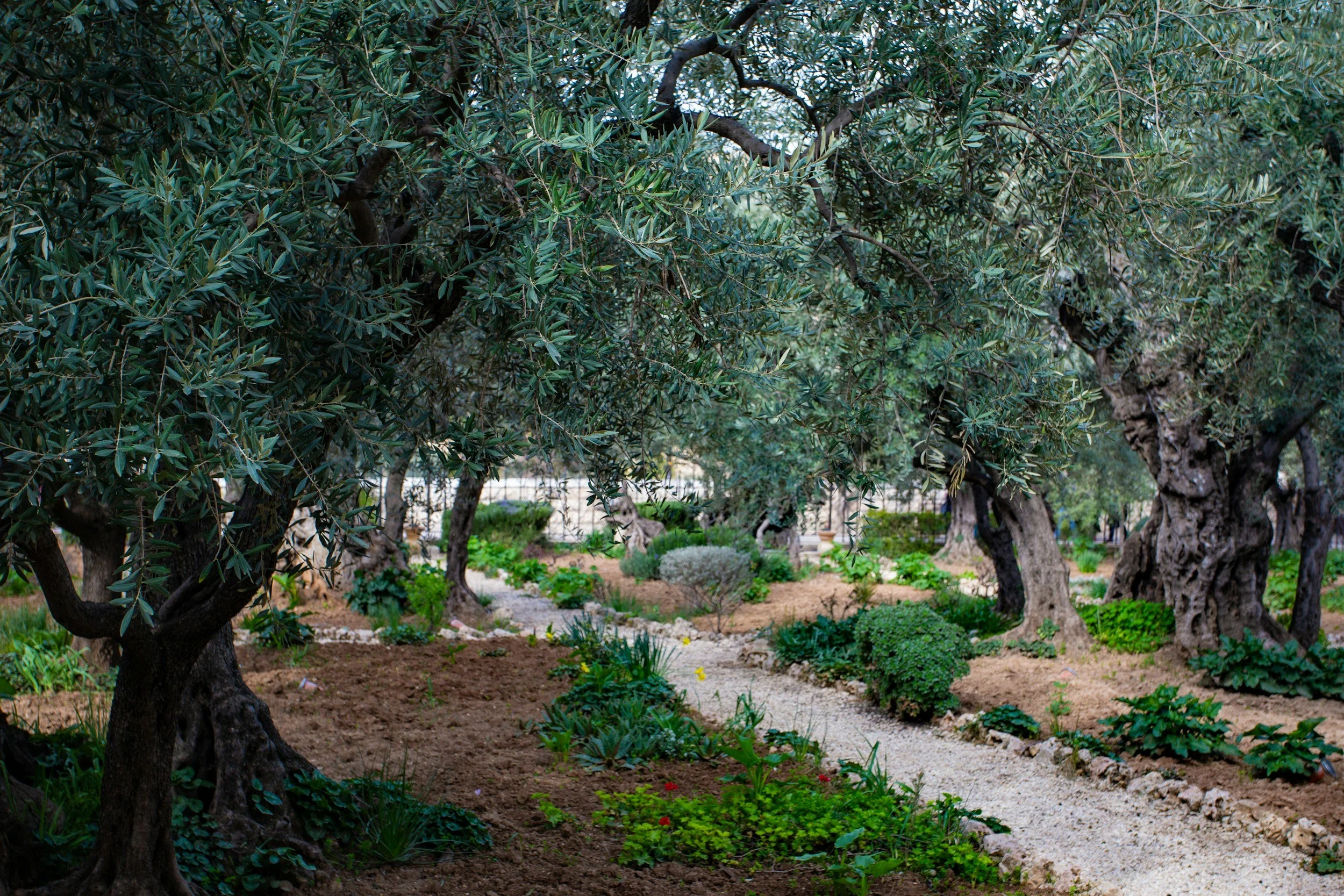
Gethsemane is a grove of olive trees, some of which are the oldest in the world.
What Does Gethsemane Mean?
Gethsemane means "oil press." The name comes from two Semitic words: gat, a press, and shemanim, oils. The Mount of Olives was covered with olive groves, and a press there would have crushed the harvest into oil for lamps, cooking, and anointing.
Olive oil was made in stages. The olives were crushed, then the pulp was stacked in baskets and pressed under heavy stone weights until the oil ran out. It is hard to miss the picture. On this night Jesus says, "I am deeply grieved, even to death" (Mark 14:34). The pressure is real, and what flows from it is not bitterness but surrender: "not what I want, but what you want."
Is it a garden?
Only John calls the place a garden: "he went out with his disciples across the Kidron valley to a place where there was a garden" (John 18:1). Matthew and Mark call it "a place called Gethsemane" (Matthew 26:36; Mark 14:32). Luke simply says Jesus went "to the Mount of Olives" (Luke 22:39). The familiar phrase "Garden of Gethsemane" puts John's description together with Matthew and Mark's name.
Think of a walled olive grove, perhaps privately owned, with a press nearby. It was not a flower garden. It was a working orchard, quiet at night, and a place Jesus knew well. John says, "Jesus often met there with his disciples" (John 18:2), which is exactly why Judas knew where to find him. Today, a group of Friars tends to Gethsemane, which is about 1/3 of an acre. During Jesus’ time it would have been much larger, but there is no consensus on what Gethsemane’s size used to be.
Where Is the Garden of Gethsemane?
The Garden of Gethsemane is in Jerusalem, Israel. It sits at the foot of the Mount of Olives, on the east side of the Old City. Between the city and the mountain runs the Kidron Valley. From the temple mount, it is a walk of well under a mile.
That short walk carried a lot of history. When King David fled Jerusalem during Absalom's revolt, he crossed the Kidron and went "up the ascent of the Mount of Olives, weeping as he went" (2 Samuel 15:23, 30). A thousand years later, the Son of David made the same crossing at night, also betrayed by someone close to him.
The Mount of Olives appears again and again in Jesus' last week:
He rode down it into Jerusalem on Palm Sunday (Mark 11:1).
He sat on it, looking at the temple, when he taught about the end of the age (Mark 13:3). See Mark 13: Keep Awake.
He went there to pray on the night of his arrest (Mark 14:26, 32).
Luke places the ascension near there, at Bethany (Luke 24:50; Acts 1:12).
Luke says Jesus went to the Mount of Olives "as was his custom" (Luke 22:39). Gethsemane was not a hiding place. It was his usual place of prayer during that week. See 6 Mountains in the Bible and What Is the Temple in the Bible?
Where is the Garden of Gethsemane in the Bible?
The Garden of Gethsemane appears in all four Gospels, always on the night of Jesus' arrest:
Matthew 26:36–56: Jesus prays three times; the arrest; "Put your sword back into its place"
Mark 14:32–52: the fullest account of the prayer, with "Abba, Father"
Luke 22:39–53: the angel and the sweat "like great drops of blood"
John 18:1–12: the only Gospel to call it a garden; the arrest and Malchus' ear
The name "Gethsemane" is used only twice, in Matthew 26:36 and Mark 14:32. The Old Testament never mentions it, but the Mount of Olives and the Kidron Valley appear often (2 Samuel 15:23–30; Zechariah 14:4).
What Happened at the Garden of Gethsemane?
Mark gives the fullest and rawest account. After the Passover meal, Jesus and the disciples sang a hymn and walked out to the Mount of Olives (Mark 14:26). On the way, Jesus told them they would all desert him, and Peter swore he never would (14:27–31).
Jesus prays at Gethsemane (Mark 14:32–36). At Gethsemane, Jesus left most of the disciples behind and took Peter, James, and John farther in, the same three who had seen his glory at the Transfiguration. Mark says he "began to be distressed and agitated" and told them, "I am deeply grieved, even to death; remain here, and keep awake" (14:33–34). Then he threw himself on the ground and prayed: "Abba, Father, for you all things are possible; remove this cup from me; yet, not what I want, but what you want" (14:36).
The disciples sleep (Mark 14:37–41). Three times Jesus came back and found them asleep. "Simon, are you asleep? Could you not keep awake one hour? Keep awake and pray that you may not come into the time of trial; the spirit indeed is willing, but the flesh is weak" (14:37–38). I’ve preached this passage several times, and I sometimes wonder if Jesus is also feeling his weakness as well. He is fully human, and feels agitated, sorrowful, and pained by what’s about to occur. He wants to be faithful, but faithfulness in this instance asks him to surrender his life.
The command "keep awake" echoes the end of Mark 13, where Jesus told them to stay alert, "for you do not know when the master of the house will come, in the evening, or at midnight, or at cockcrow, or at dawn" (13:35). Those are the hours of this very night: the supper in the evening, Gethsemane around midnight, Peter's denial at cockcrow, the trial at dawn. See No One Knows the Day or Hour.
Judas arrives (Mark 14:43–46). Judas came with a crowd carrying swords and clubs, sent by the chief priests. His signal was a kiss: "Rabbi!" Jesus was seized.
Everyone runs (Mark 14:47–52). Someone drew a sword and cut off the ear of the high priest's slave. Jesus asked why they came for him like a bandit when he had taught openly in the temple every day. Then "all of them deserted him and fled" (14:50). Mark alone adds a young man who ran away naked, leaving his linen cloth behind (14:51–52). Jesus, in just a fewe hours, will also be stripped.
| Mark 14:32–52 | Matthew 26:36–56 | Luke 22:39–53 | John 18:1–12 | |
|---|---|---|---|---|
| Name of the place | "A place called Gethsemane" | "A place called Gethsemane" | The Mount of Olives, "as was his custom" | A garden across the Kidron |
| Jesus' prayer | "Abba, Father... remove this cup from me" | "My Father, if it is possible, let this cup pass from me" | "Father, if you are willing, remove this cup from me" | No agony prayer; "Am I not to drink the cup that the Father has given me?" |
| How many times | Three returns to the sleeping disciples | Three, with a second prayer quoted | Once | None |
| Unique details | "Abba"; the young man who flees naked | "Twelve legions of angels" (26:53) | An angel strengthens him; sweat "like great drops of blood" | The arresting party falls back at "I am he" |
| The sword | "One of those who stood near" | "One of those with Jesus" | Jesus heals the slave's ear | Peter strikes Malchus |
| The disciples | All desert him and flee | All desert him and flee | "Sleeping because of grief" | Jesus asks that they be let go |
Luke's account is worth reading closely. He alone says Jesus withdrew "about a stone's throw," that an angel came to strengthen him, and that "his sweat became like great drops of blood falling down on the ground" (Luke 22:41–44). Some early manuscripts do not include verses 43–44, which is why many Bibles print them in brackets. Read the full study: Jesus Prays on the Mount of Olives (Luke 22:39–46), along with the Luke 22 summary and outline and Jesus Foretells Peter's Denial (Luke 22:35–38). For John's version, see the John 18 outline and meaning.
Did Jesus Sweat Drops of Blood?
As you’ve just read from Luke, while in Gethsemane, Jesus’ “sweat became like great drops of blood falling down to the ground” (Luke 22:41-44). I grew up hearing that he literally sweated blood. I remember asking my biology teacher if that could be true. It’s such a stark passage to read, and painful to think Jesus went through such distress.
There are a few ways scholars have viewed this. Some see the passage as a simile, which is strongly supported in the original language of the text, Koine Greek. Luke uses the word hosei (“like” or “as”) to describe the sweat falling as thickly and heavily as clotting drops of blood (thromboi haimatos).
The passage states that Jesus was in agonia, a Greek term that describes severe mental distress, terror, and emotional conflict. He is being pressed in anticipation of the physical and spiritual suffering he is about to undergo.
There are two theories that seek to describe what’s happening: The Profuse Sweat View holds that the psychological terror causes such violent physiological arousal that his sweat became viscous and heavy, dropping thickly and heavily to the dirt, almost like the consistency of blood from an open wound. The Medical View involves Hermatidrosis. This is a rare but documented condition where extreme, life-threatening stress causes the capillary blood vessels feeding the sweat glands to rupture, resulting in sweat that is literally tinged with blood.
Either interpretation gets us to the point: Jesus, by saying no to his own will and taking up the cup of suffering, is in an olive grove that has a wine press, and he is being crushed by the weight of the moment.
The Garden of Gethsemane Prayer by Jesus
Jesus' prayer in Gethsemane is one of the most honest prayers in the Bible. He asks for the suffering to be taken away, and he surrenders to the Father in the same breath. Matthew, Mark, and Luke each record it:
Mark 14:36: "Abba, Father, for you all things are possible; remove this cup from me; yet, not what I want, but what you want."
Matthew 26:39: "My Father, if it is possible, let this cup pass from me; yet not what I want but what you want."
Matthew 26:42: "My Father, if this cannot pass unless I drink it, your will be done."
Luke 22:42: "Father, if you are willing, remove this cup from me; yet, not my will but yours be done."
Notice how Matthew's second prayer has moved. The first asks for the cup to pass. The second has already begun to accept it: "your will be done." Those are the same words Jesus taught his disciples in the Lord's Prayer (Matthew 6:10). In Gethsemane, Jesus prays his own prayer under the heaviest weight imaginable.
The prayer teaches us three things about praying in our own hard nights:
Tell God the truth. Jesus said, "I am deeply grieved, even to death." He did not pretend.
Ask for what you want. "Remove this cup" is a real request. It is not a lack of faith to ask God to change things.
End in trust. "Not what I want, but what you want" is not giving up. It is putting yourself in the hands of a Father you trust.
A Gethsemane Prayer for Us to Pray
Abba, Father, you know what I am facing tonight, and you know I am afraid. If there is another way, please open it. If there is not, give me the strength to walk the way in front of me. Keep me awake to you. Not what I want, but what you want. Amen.
For more, see 43 Prayers in the Bible and Bible Verses About Confident Prayer.
Why Gethsemane Matters
Gethsemane shows us Jesus at his most human and his most faithful at the same moment. Four things happen there that shape Christian faith.
1.The cup
When Jesus prays "remove this cup from me," he is drawing on an Old Testament image. The prophets spoke of "the cup of his wrath" that God's people or the nations would drink in judgment (Isaiah 51:17; Jeremiah 25:15). Jesus had already asked James and John, "Are you able to drink the cup that I drink?" (Mark 10:38). In Gethsemane, he faces that cup in full: suffering, rejection, and death on behalf of others. He does not pretend it is easy. He asks for another way, and then he accepts the Father's way. See Bible Verses About Jesus' Death.
2."Abba, Father"
Mark keeps the Aramaic word Jesus used: Abba, the word a child uses for a father. In his worst hour, Jesus prays with intimate trust. Paul says believers pray the same way because the Spirit of the Son lives in them: "When we cry, 'Abba! Father!' it is that very Spirit bearing witness with our spirit that we are children of God" (Romans 8:15–16; Galatians 4:6). See Abba Father Meaning.
3.The sleeping disciples
Jesus asked his closest friends to stay awake with him, and they could not. He was not angry so much as honest: "the spirit indeed is willing, but the flesh is weak" (Mark 14:38). Gethsemane is a picture of how alone Jesus was, and of how much grace he would have to extend to friends who failed him. Within hours, Peter would deny him three times.
4.Eden and Gethsemane
The Bible's story turns on two gardens. In Eden, the first Adam reached for what he wanted against God's command. In Gethsemane, Jesus said "not what I want, but what you want" and chose the Father's. What was lost in one garden begins to be restored in the other. Read more in Jesus the Second Adam: How Gethsemane Reverses the Fall of Eden and What Does Eden Symbolize in the Bible?
Hebrews looks back on this night: "In the days of his flesh, Jesus offered up prayers and supplications, with loud cries and tears, to the one who was able to save him from death" (Hebrews 5:7). Because of Gethsemane, we have "a high priest who is able to sympathize with our weaknesses" (Hebrews 4:15).
Pastor's heads-up: This passage reminds me of a church member I once knew, who is now with the Lord in heaven. I visited him in the hospital late one night. He started telling me a story, “Jason, when I was 16, I was playing golf with a few friends. At one point, they walked ahead, and I sat down under a shade tree to rest. All of a sudden, I blurted out, “God, I’ll go where you want me to go, and I’ll do your will. My life is yours.” Subsequently, he entered World War II as a young man and fought in one of the decisive battles, the Battle of the Bulge. He saw and experienced very difficult things there. After the war, he returned here to Poughkeepsie. He gave his life to public service, serving in local government, and he served for decades as an elder in the church. As he lay in the hospital bed, he had the same attitude, even as he approached life’s ending, “My life is yours.”
A guardrail: what Gethsemane does not teach
It does not mean Jesus lacked faith. Fear and grief are not sin. Jesus brought both honestly to the Father and still obeyed. If you have prayed "take this away" and felt ashamed afterward, Jesus prayed it first.
It does not mean the Father and the Son were at odds. Jesus' prayer ends in agreement, not rebellion. The Son freely chooses the Father's will.
It does not mean unanswered prayer is a lack of faith. Jesus' request was not granted in the form he asked. His trust was not weaker for it.
It does not support violence in Jesus' name. The one disciple who drew a sword was told to put it away (Matthew 26:52; John 18:11), and in Luke, Jesus healed the wound (Luke 22:51).
For the hard nights of your own life, these may help: Bible Verses About Anxiety · Bible Verses About Worry · Bible Verses About Depression · Bible Verses About Trust · Bible Verses About Abandonment · Bible Verses About Lament · How to Pray When I Am Sad
Gethsemane Today
Visitors to Jerusalem can still walk to Gethsemane at the foot of the Mount of Olives. Two things mark the site.
The Church of All Nations. Also called the Basilica of the Agony, it was completed in 1924 with gifts from many countries, which gives it its name. It stands over a section of bedrock that tradition identifies as the place where Jesus prayed. Earlier churches stood on the same spot, going back to the fourth century. The interior is kept dim, with deep violet glass, to suggest the night of the agony.
The olive trees. Beside the church is a small grove of eight very old olive trees. A scientific study published in 2012 dated some of them to the twelfth century, roughly 900 years old, and found they may have grown from the same parent tree. Their root systems may be older still. They are not the trees Jesus knelt among, since Roman armies cut down the trees around Jerusalem during the siege of AD 70, but they are among the oldest olive trees known anywhere.
Nearby are the Grotto of Gethsemane, a cave that some traditions associate with the disciples resting that night, and the Russian Orthodox Church of Mary Magdalene with its golden domes higher up the slope.
Whether or not you ever visit, Gethsemane is a place Christians return to every year. On Maundy Thursday, many churches end worship in darkness and silence, keeping watch the way Jesus asked his friends to. See Prayers of Illumination for Lent, Holy Week, and Easter.
The Garden of Gethsemane in art
Few scenes have been painted more often, usually called The Agony in the Garden. Andrea Mantegna and Giovanni Bellini both painted it in the 1450s and 1460s, with the disciples asleep in the foreground and soldiers approaching in the distance. El Greco painted an angel bending toward Jesus in a cloud. Heinrich Hofmann's Christ in Gethsemane (1890) became one of the most reproduced religious images in America. Arkhip Kuindzhi's Christ in the Garden of Gethsemane(1901) shows Jesus as a lone figure in a shaft of moonlight among dark trees. For more on reading Christian art, see The Transfiguration by Raphael.
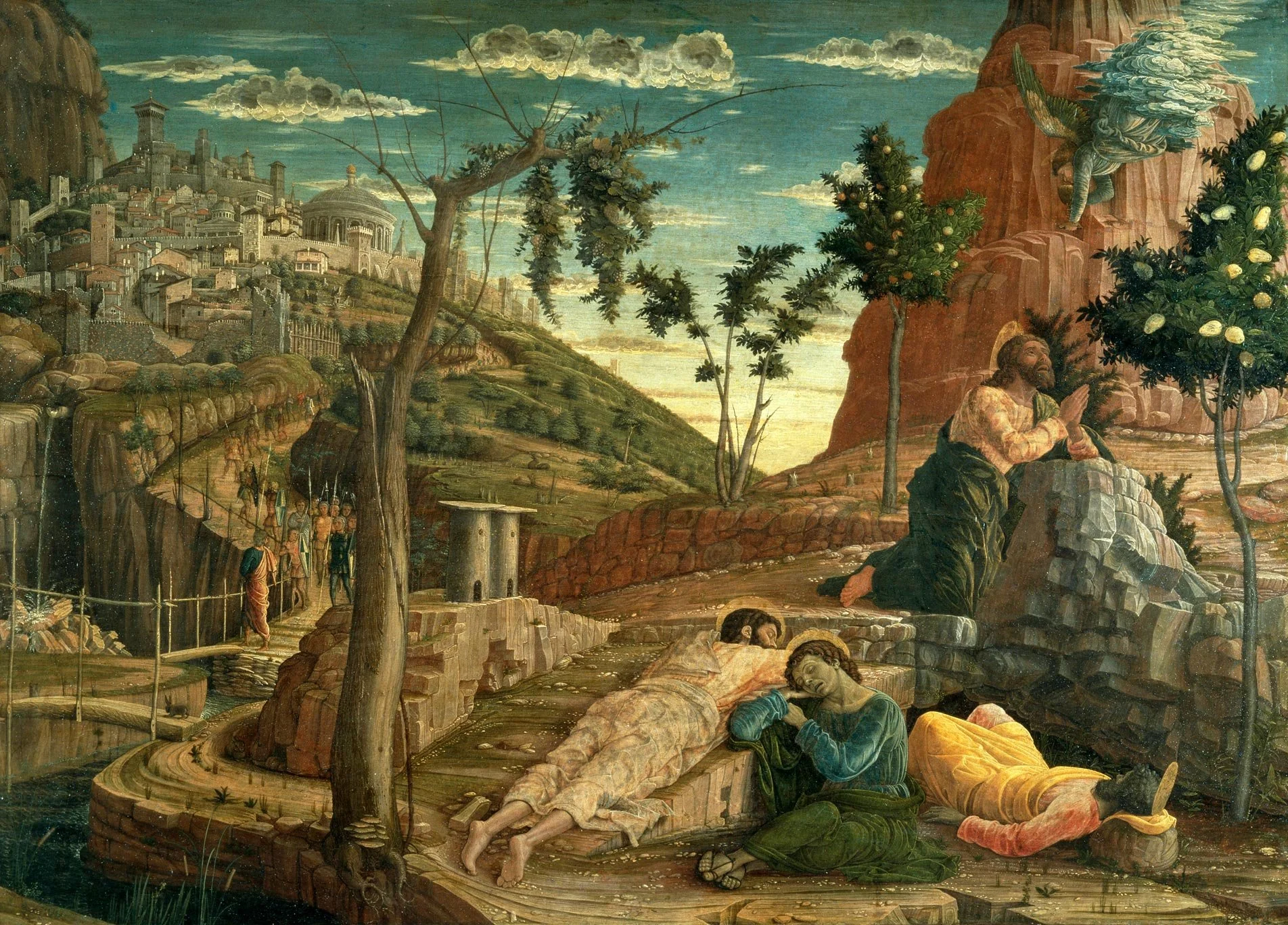
The Agony in the Garden by Andrea Mantegna and Giovanni Bellini. Jerusalem on the hill, down the Kidron Valley, the approaching mob, the disciples asleep, and Jesus praying.
FAQ
What happened at the Garden of Gethsemane? On the night before his crucifixion, Jesus prayed there in deep anguish, asking the Father to remove "this cup" but submitting to the Father's will. His disciples fell asleep. Then Judas arrived with an armed crowd, identified Jesus with a kiss, and Jesus was arrested.
What does the word Gethsemane mean? It means "oil press." Olives from the Mount of Olives were crushed there for oil.
Where is the Garden of Gethsemane located? At the foot of the Mount of Olives, just east of Jerusalem's Old City, across the Kidron Valley from the temple mount.
Why did Jesus go to Gethsemane? To pray. Luke says Jesus went to the Mount of Olives "as was his custom" (Luke 22:39), and John says Jesus often met there with his disciples (John 18:2). He went knowing Judas would find him there.
What was the cup Jesus asked to be removed? The cup is a biblical image for suffering and for God's judgment on sin (Isaiah 51:17; Mark 10:38). Jesus was facing the cross, and he asked if there was another way before accepting the Father's will.
Did Jesus really sweat blood? Luke says "his sweat became like great drops of blood" (Luke 22:44). Note the word "like": Luke may be describing how heavily he sweated rather than literal blood. Doctors have described a rare condition, hematidrosis, in which extreme stress causes blood to mix with sweat. Some early manuscripts of Luke do not include this verse.
Which disciples were with Jesus in Gethsemane? Eleven disciples went with him; Judas had already left to betray him. Jesus took Peter, James, and John farther in with him to keep watch.
Who cut off the servant's ear in Gethsemane? Matthew, Mark, and Luke do not name him. John says it was Peter, and that the servant's name was Malchus (John 18:10). Luke adds that Jesus touched the ear and healed him (Luke 22:51).
Can you visit the Garden of Gethsemane today? Yes. The site beside the Church of All Nations in Jerusalem has an olive grove with trees dated to about 900 years old.
How do you pronounce Gethsemane? geth-SEM-uh-nee, with the stress on the second syllable.
Is the Garden of Gethsemane a real place? Yes. The Gospels place it on the Mount of Olives outside Jerusalem, and Christians have marked the site since at least the fourth century. The exact spot where Jesus prayed cannot be proven, but the general location is not in doubt.
Keep Studying
Gethsemane in the Gospels
Bible Facts
Go deeper
Bible verses about
