What is the Mount of Transfiguration?
Quick Summary
The Mount of Transfiguration is the mountain where Jesus was revealed in glory before Peter, James, and John. There, Jesus’s appearance changed, Moses and Elijah appeared, and a voice from heaven identified him as God’s beloved Son. The Transfiguration confirms Jesus’s identity, connects him to Israel’s story, and prepares the disciples for the suffering that lies ahead.
Introduction
The Transfiguration is one of the most mysterious and theologically dense moments in the Gospels. It happens briefly, away from crowds, witnessed by only three disciples. There are no parables, no healings, no debates. Instead, there is light, voice, fear, and silence.
The Gospels describe this event not as a vision but as a revelation. Something true about Jesus is unveiled, not added. The Mount of Transfiguration becomes a place where heaven and earth meet, where Israel’s past and future converge, and where the disciples glimpse who Jesus truly is before they watch him walk toward the cross.
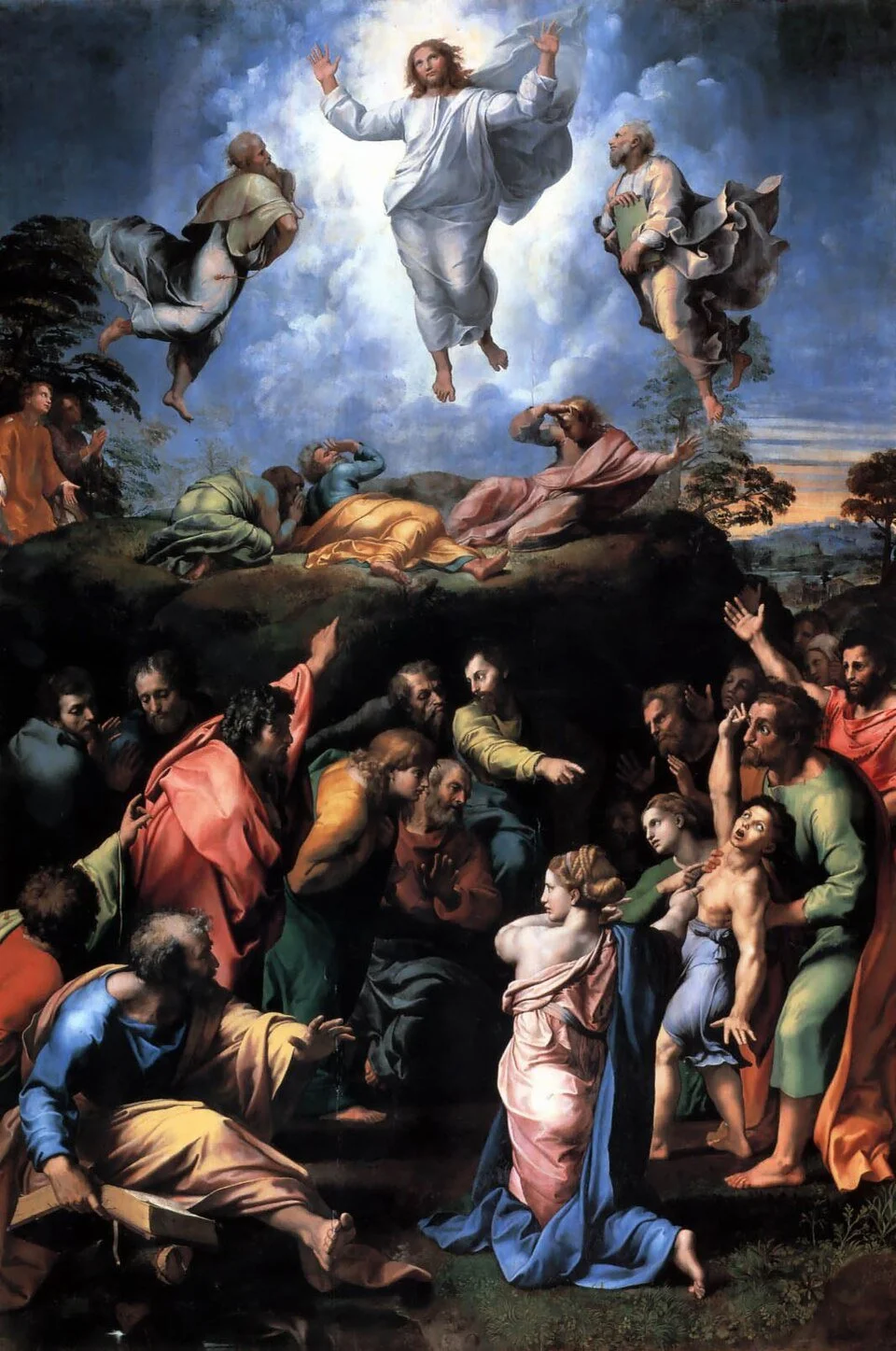
Revelation above with suffering below. Read about Rafael’s painting of the Transfiguration of Jesus Christ in the Faith in Art section.
What Happened at the Transfiguration?
The Transfiguration is recorded in Matthew 17:1–8, Mark 9:2–8, and Luke 9:28–36. Jesus takes Peter, James, and John up a high mountain. While there, his appearance changes. His face shines, his clothes become dazzling, and Moses and Elijah appear speaking with him.
A cloud overshadows them, and a voice declares, “This is my Son, my Chosen; listen to him.” The disciples fall to the ground in fear. When they look up again, they see only Jesus.
Each Gospel emphasizes slightly different details, but all agree on the central claim: Jesus is revealed as God’s Son, standing in continuity with the Law and the Prophets.
(Sources: R.T. France, The Gospel of Matthew, pp. 646–652; Joel Marcus, Mark 8–16, pp. 632–640)
Why Moses and Elijah Appear
Moses and Elijah represent the Law and the Prophets, the two major divisions of Israel’s Scriptures. Their appearance signals that Jesus does not replace Israel’s story but fulfills it.
Luke adds that Moses and Elijah speak with Jesus about his “departure,” using the word exodos (Luke 9:31). This frames Jesus’s coming death as a new Exodus, one that will bring deliverance not just from Egypt, but from sin and death.
The disciples’ impulse to build shelters reflects a desire to preserve the moment. Scripture, however, moves them forward. The glory cannot be contained.
(Sources: N.T. Wright, Jesus and the Victory of God, pp. 389–394; Dale C. Allison Jr., The New Moses, pp. 243–247)
The Voice from the Cloud
The divine voice echoes earlier moments in the Gospel story. At Jesus’s baptism, a similar declaration names him as God’s beloved Son. Here, the voice adds a command: “Listen to him.”
The cloud recalls Sinai, where God’s presence descended in fire and smoke. The Transfiguration thus places Jesus within Israel’s most sacred memory, but also elevates him. The voice does not say, “Listen to Moses and Elijah.” It points only to Jesus.
The authority of Jesus is no longer inferred. It is declared.
(Sources: Craig S. Keener, The Historical Jesus of the Gospels, pp. 292–296; Richard B. Hays, Echoes of Scripture in the Gospels, pp. 202–206)
Where Was the Mount of Transfiguration?
The Bible never names the mountain. Christian tradition often identifies it as Mount Tabor in Galilee, while many scholars argue for Mount Hermon due to its height and proximity to Caesarea Philippi.
Scripture itself resists certainty. The Gospel writers are less concerned with geography than theology. The mountain functions symbolically as a place of revelation, echoing Sinai and anticipating the Mount of Olives.
The lack of precision keeps the focus on meaning rather than location.
(Sources: Jerome Murphy-O’Connor, The Holy Land, pp. 320–324; Craig A. Evans, Jesus and His World, pp. 179–181)
How the Transfiguration Prepares the Disciples
The Transfiguration follows Peter’s confession of Jesus as the Messiah and Jesus’s first prediction of his suffering. The sequence matters. Glory comes before the cross, but does not cancel it.
Jesus tells the disciples not to speak of what they have seen until after the resurrection. The experience cannot yet be understood. Only in light of the empty tomb will its meaning become clear.
The Transfiguration strengthens the disciples for what they are about to witness: betrayal, suffering, and death. It assures them that the path to the cross is not failure, but obedience.
(Sources: Morna D. Hooker, The Gospel According to St Mark, pp. 221–225; Dietrich Bonhoeffer, Discipleship, pp. 83–86)
Why the Mount of Transfiguration Matters
The Transfiguration reveals that suffering does not have the final word. Jesus’s identity is grounded not in power or spectacle, but in faithful obedience to God’s will.
For the church, the Mount of Transfiguration holds together glory and humility, revelation and silence. It reminds readers that faith often includes moments of clarity meant to sustain long seasons of trust.
The disciples are not told to build monuments. They are told to listen, descend the mountain, and follow.
(Sources: Willie James Jennings, The Christian Imagination, pp. 271–274; Fleming Rutledge, The Crucifixion, pp. 55–59)
FAQs
What does the Transfiguration reveal about Jesus?
The Transfiguration reveals Jesus as God’s beloved Son and the fulfillment of the Law and the Prophets. It confirms his divine authority before his suffering and death.
Why were only three disciples present?
Peter, James, and John form Jesus’s inner circle in the Gospels. Their presence underscores the significance of the event and prepares future leaders of the early church.
Is the Transfiguration a vision or a real event?
The Gospel writers present it as a real historical event experienced by the disciples, not merely a symbolic vision.
Why did Jesus forbid the disciples to talk about it?
Jesus knew the event could not be understood apart from the resurrection. Silence protected the truth from misunderstanding.
Works Consulted
Allison, Dale C. Jr. The New Moses. Fortress Press.
Bonhoeffer, Dietrich. Discipleship. Fortress Press.
Evans, Craig A. Jesus and His World. Westminster John Knox.
France, R.T. The Gospel of Matthew. Eerdmans.
Hays, Richard B. Echoes of Scripture in the Gospels. Baylor University Press.
Hooker, Morna D. The Gospel According to St Mark. Hendrickson.
Keener, Craig S. The Historical Jesus of the Gospels. Eerdmans.
Marcus, Joel. Mark 8–16. Yale University Press.
Murphy-O’Connor, Jerome. The Holy Land. Oxford University Press.
Wright, N.T. Jesus and the Victory of God. Fortress Press.
