The Worst Thing We Could Be
Introduction
Text: Matthew 28:19-20; Acts 6:1–7
The whole world is in America right now for the World Cup. Over a million fans have crossed oceans to follow 48 countries competing across our nation, seeing the US for the very first time.
What I’ve been enjoying most aren't the matches, but the videos of visitors posting their impressions on social media. There is a young man from Germany who went viral just by being utterly amazed. He walked into a Waffle House at 1:00 AM and reviewed it like a fine-dining experience.
He visited a Buc-ee’s and couldn't believe a gas station could have 70 gas pumps, fresh brisket, hunting gear, and kayaks.
Other Europeans felt like they were in a fairy tale just seeing a big yellow school bus.
They are stunned by how friendly a total stranger will be for no reason at all. Many exclaim, “We’ve been lied to about America. These are genuinely some of the nicest people on earth.” They came expecting one thing and found another.”
If you look past the fans, you realize those matches only happen because of an incredible discipline behind the scenes. Millions enjoy the games because thousands of people know their role, do their jobs, and work in sync.
Structure makes the celebration possible.
Just as people wonder about what it’s like to live in America, people also wonder what it’s like to be part of a church: to work for one, serve one, or lead one.
Sometimes when a new staff member, elder, or deacon comes on board, I will sit down with them for a forthright conversation. I tell them the truth: from the pews, the church looks beautiful and seamless. There is music, light, order, and grace. It all just seems to happen.
But now, you are going to get deep into the weeds. You’re going to find out how fast things move, how slow things move, how many moving parts there are, and what it takes to hold all of this together.
And then I say my go-to phrase: I like sausage, and you’re about to see how the sausage gets made.
That’s not a failure to live up to a pretty vision; it’s just what the church looks like up close. A working kitchen is a mess. An active, engaged, and growing church is sometimes like that kitchen. It’s a sign of life.
But for life to thrive, it needs order, structure. And it has always been this way, from the very beginning.
Our passage in the New Testament book of Acts shows us the life of the very first Christians. They had all heard the gospel, the grace of God found in the teachings and the person of Jesus Christ. It lit them on fire. They opened their homes to one another, shared their possessions, and took care of one another. Growth piled upon growth, and the Christian community grew to over 5,000 people in a very short amount of time.
And running and overseeing the whole thing? Twelve men, the apostles. Since they had been eyewitnesses to Jesus and heard his teaching firsthand, they spent their time preaching, praying, teaching, and trying to meet every single daily need of the people. Soon, there was simply not enough hours in the day. The kitchen, so to speak, was a mess.
When a church gets complex, the seams start to pull apart. In the text, a group clears their throat and says what has been heard in every church since: “I feel left out. They don’t see us.” The Greek-speaking widows were being passed over in the daily food line.
Notice what the apostles don’t do. They don't promise to just work harder and sleep less. They don't tell people to stop complaining. But they also don't say, "Everyone just pitch in and do whatever you want."
Instead, they realize that blurring the lines threatens the mission itself. They say, “It is not right that we should give up preaching the word of God to serve tables.” They realize if they get stuck managing the kitchen, the whole ship sinks. So, they establish a healthy boundary. They build a structure.
They ask the church to choose seven trusted leaders to manage the food line. Interestingly, every single person chosen had a Greek name. The people chose their representatives. How presbyterian of them! The very people who felt unseen became the ones empowered to do the serving.
This was the birth of the Deacon. The word deacon means “to serve.”
Meanwhile, Elders were set apart to oversee the big picture, teach, and pray.
Nobody carries it all. The load gets shared, the lines of play become clear, and everyone follows their role. The people choose and trust their elected leaders. Because those extra stressors were lifted, the team got back in sync, the word of God spread, and the church multiplied even more.
Our Turn to Go Forward
This is the Great Commission. Jesus said, “Go and make disciples.” And in Acts 1, Christ tells them to be witnesses in Jerusalem, Judea, Samaria, and to the ends of the earth.” And the entire book of Acts is that one command being lived out, one obstacle at a time. The church trusts, they organize, they stay creative, and they spread. Forward. Forward. Forward.
Forward is the whole story. And forward is our word, too.
For one hundred and ninety-nine years, this congregation has gone forward. From the first meetings to the construction of this building, to expanding our footprint to serve our community. Generations have built and stewarded this ministry, handed it forward, and said, “It’s your turn. In God’s grace, go forward.”
We are at an important moment. We are entering our bicentennial year. We are going to spend a lot of time talking about moving forward in this ministry.
I’ll now ask Mike or Anthony to display something on the screen.
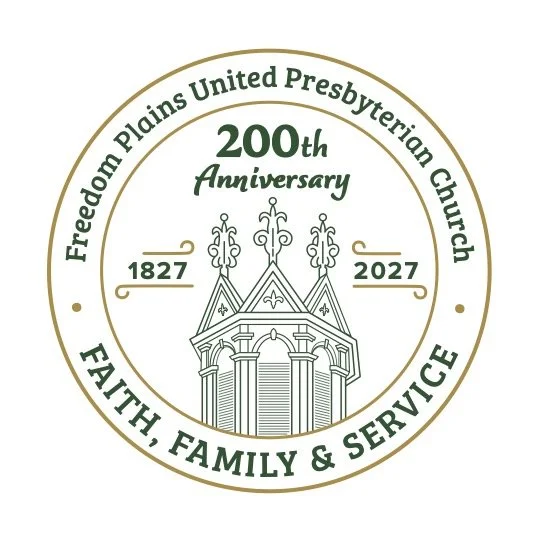
[LOGO REVEAL — Freedom Forward]
Our theme for these next 13 months is “Freedom Forward: Celebrating two hundred years of faith, family, and service.” You’re going to see this logo around here a lot. It may even show up on some Christmas ornaments or other items. You just never know.
We are Freedom Plains. Our roots are anchored deep in our tradition, our theology, our past, and our purpose. And having anchored roots is exactly what allows us to stretch out and grow.
Over the next 13 months, we are going to stretch forward. We are going to have a variety of social events, learning opportunities, and service projects. There are going to be a lot of calls to action—calls to step forward. We are rooted in grace and the gospel, and the grace and the gospel always call us forward.
In fact, today during coffee hour, you will hear about a plan to finish our patio project. When we completed our new wing about a decade ago, the patio was part of the plan, but it wasn't completed at the time for budgetary reasons. We are going to complete it.
And then, next July, we are going to gather and throw a massive birthday party that is worthy of 200 years!
Anchored in our past, stretching forward.
Good things were happening here long before I arrived, and over the past 16 months, good things have happened and are happening.
I’ll give you a few examples.
Our nursery school, led by Kelly Burghart, had a waitlist in January for this upcoming year. At capacity and staffed with passionate and skilled teachers.
Our Christian Education Committee is working right now to find out what it would take to bring back Vacation Bible School for the first time in almost a decade. For it to work, we are going to have to stretch forward. We will need you.
And as we have been moving forward, our building continues to function as the de facto meeting place for our community. Over 50 events are taking place in our building this month alone.
Because of this incredible growth, we brought Heather Peterson on specifically to be present in the building when certain groups are using our space. Besides working and representing us, you may see her up here doing some volunteer work. As a matter of fact, you may see her around here more often than the family of groundhogs who are now living under the shed out back.
There is life and movement here. We are a complex organization.
Counting the nursery school and all part-time and full-time employees, we employ over 15 people who help us carry out ministry. We have over a dozen deacons and over a dozen elders. We have well over 15 committees, led by volunteer committee chairs.
Between staff, elders, and deacons, that is over 40 people we are investing in, praying for, coaching. 40! It takes a lot of intentional effort to get us on the same page.
Every now and again you may hear someone ask, “Wait... there’s a page?” Yes, there is—but sometimes a few of us are accidentally holding the page upside down!
Sourcing the Ingredients
Communication is going to be an important focal point for us over the next year. Not perfection, but a commitment to a process of steady improvement.
I want you to know what’s going on. I want you to be able to plan your participation.
There are going to be a lot of details about upcoming events in this bicentennial year. And this brings us back to the sausage.
A working kitchen is a mess. When the sausage gets made, the workers talk out loud. That’s what happens in kitchens. They wonder about things, they throw ideas around, and sometimes they offer those raw ideas to you.
Just know: when that happens, they are simply sourcing ideas and ingredients. They are brainstorming. You might hear a whisper about this project or that event, but until it is officially printed and communicated, we’re just making the sausage.
If you ever have a question or interest about why something is being done or if something you heard is true, feel free to talk to me. Call me, email, or drop by my office. If I can’t answer it, I’ll find someone who can. Fair warning, though. I may be the one holding the page upside down.
The House We Are Building
200 years! What a special thing to be a part of.
Being a church that is learning how to communicate better is not the worst thing we could be. Being a church that is learning to trust staff to be professionals, to develop and grow, to do their job in their own way with my supervision and support, is not the worst thing we could be.
I’m about to tell you the worst thing we could be.
The whole world is wandering around America this summer saying, “I had no idea—so this is what it's like. I want to come back.”
I’ve entrusted my own kids into your care. You are helping them develop their character and their faith. I believe my family—and anyone else’s family—would benefit from being part of our church. My friends who don’t go to church would not only benefit but would be embraced if they came here.
People who are carrying heavy burdens and facing difficult life issues are supported here, prayed for, talked to, respected, and treated well.
People who are struggling or are unsure of their faith come here, are not outcasts, but are seen, appreciated, loved, embraced, and invited to participate. Here, men and women and people of all types of categories belong and contribute.
Just like in Acts 6, we want to be a church that notices gaps in our service or in our methods, and then intentionally makes changes to get better so we can serve better.
So, I will tell you what the worst thing we could be. It goes back to an old phrase we’ve all heard: “The best-kept secret in town.”
What business out there wants to be a secret?
And that—that—is the worst thing we could be. The best-kept secret.
So we won't be a secret. We will organize ourselves, improve where we need to, invest in our people, so that we can dream dreams as big as our God. Hey, maybe we will like the sausage after all.
This bicentennial year, all of our events will provide us with the opportunity to get the word out, to make connections, and to build new friendships. I want the community to see why Freedom Plains United Presbyterian Church is one of the best ones around.
When people walk through our doors this year, I want them to see a church that is rooted, growing, and playing in sync. A house of deep peace, clear vision, and wide-open hospitality. Rooted in the past, growing forward.
Two hundred years of faith, family, and service with the doors thrown wide open.
Freedom, let’s go forward.
