What Is the Tabernacle in the Bible? Dimensions and Meaning
Quick Summary
The Tabernacle was the portable sanctuary Israel carried through the wilderness and used until the construction of Solomon’s Temple. Its layout followed a precise pattern given in Exodus 25–31, with a courtyard, a Holy Place, and the Most Holy Place. The structure was built to reflect God’s holiness, Israel’s calling, and the promise of divine presence in the midst of a wandering people. Its dimensions stood as a visible reminder that worship involved order, beauty, and nearness to God.
Introduction
The Tabernacle is one of the most detailed architectural descriptions in all of Scripture. With measurements, materials, and furniture listed with intention, the Tabernacle served as both a physical meeting place and a theological statement. It was a sanctuary built during Israel’s desert years, a symbol of the God who travels with a displaced people. Its portable walls and sacred spaces held a message of presence, faithfulness, and promise.
In my early Christian walk, my pastor gave me a copy of the Holman Bible Commentary. I remember being fascinated with the Tabernacle and Temple. It stirs the imagination and educates us about God’s unrelenting desire to show us mercy. More importantly, it points us to Jesus Christ, whom John says is a tabernacle.
Understanding its size and structure helps illuminate the rhythms of Israel’s worship. Every measurement carried meaning. Every space within the Tabernacle shaped how Israel approached God. Within its curtains and courts, the story of redemption took on visible form. The Tabernacle was a sign that pointed to the God who draws near.
If you are interested in the various festivals and seasons mentioned in Scripture, you can visit the Dates, Times, & Seasons Library.
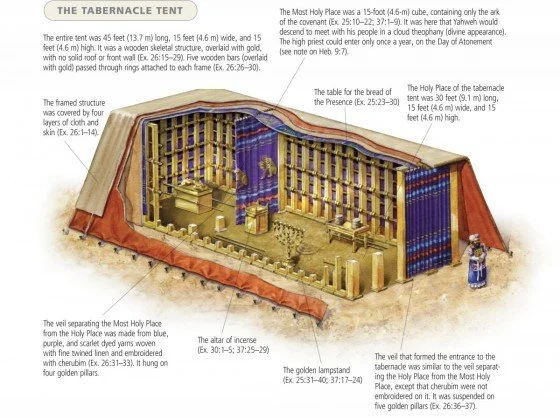
In this image, available through the ESV Study Bible, copyright 2008 (Crossway Bibles), one sees the various layers and furniture of the tabernacle.
The Structure of the Tabernacle
The Tabernacle stood within a rectangular courtyard that stretched roughly one hundred cubits by fifty cubits. The walls were formed by linen hangings. The entrance faced east, inviting worshipers to step from ordinary life into sacred space. Within this enclosure stood the Tabernacle itself, a tented structure framed in acacia wood and draped with layers of fabric and coverings.
The inner structure measured thirty cubits long, ten cubits wide, and ten cubits high. Curtains embroidered with cherubim formed the inner walls. Over these hung goat hair, ram skins dyed red, and another protective layer. Nothing in the design was accidental. The layers symbolized both beauty and protection, reminding Israel that holiness requires both honor and care.
Inside, two distinct spaces shaped the rhythm of worship. The larger chamber, the Holy Place, held the lampstand, the table of the bread of the Presence, and the altar of incense. Beyond the veil lay the Most Holy Place. This was the heart of the Tabernacle, the space where only the high priest entered once each year. Within it rested the Ark of the Covenant, the sign of God’s covenant presence.
The Tabernacle at a Glance
| Zone / Feature | Dimensions & Specifications | Key Furnishings & Purpose |
|---|---|---|
| The Courtyard | 100 cubits by 50 cubits (enclosed by linen hangings) | Altar of burnt offering, bronze basin; place of public approach and cleansing. |
| The Holy Place | 30 cubits long, 10 cubits wide, 10 cubits high | Lampstand, table of the bread of the Presence, altar of incense; daily priestly ministry. |
| The Most Holy Place | 10 cubits by 10 cubits by 10 cubits (cube shape) | Ark of the Covenant and mercy seat; symbol of God's immediate presence entered once a year. |
The Courtyard: A Place of Approach
The courtyard formed the outer boundary of Israel’s worship life. It held the altar of burnt offering and the bronze basin. Here sacrifices were presented, and here the priests washed before tending to their duties. The open-air design reminded Israel that the first step toward God always begins with cleansing and commitment.
The altar’s size and placement highlighted its central role. Rising above the surrounding space, it was the first object encountered through the entrance. The journey toward God moved from sacrifice to cleansing, from cleansing to worship, and from worship to encounter. The courtyard framed the path.
The courtyard also served another purpose. Its openness meant that the people could see the movements of the priests. Worship was not hidden. It was lived in community. The Tabernacle taught that worship involves the life of the whole people, not the privacy of a select few.
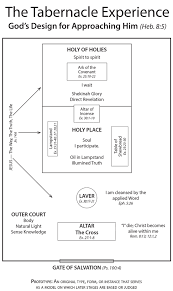
An overhead view of the Tabernacle complex. Source.
The Holy Place: A Space of Daily Ministry
The Holy Place held the lampstand, its branches giving constant light. Opposite it, the table of the bread of the Presence stood as a sign of God’s provision. The altar of incense stood closest to the veil, its rising smoke symbolizing prayer and offering. These objects gave shape to daily worship.
The priests tended the lampstand morning and evening. They replaced the bread each week. They offered incense as part of their regular service. These rhythms taught Israel that worship is ongoing. The Holy Place was a place of constancy. Its steady light, fresh bread, and fragrant incense reminded Israel that life with God is sustained daily.
The dimensions of the Holy Place made it intimate but not cramped. It was a working room, a space where priests moved back and forth. Its proportion conveyed balance. Nothing was oversized. Nothing was out of place. The room itself invited reverence.
The Most Holy Place: A Symbol of Divine Presence
Separated by a finely woven veil, the Most Holy Place measured ten cubits by ten cubits by ten cubits. This cube-like shape signaled perfection and completeness. Within the chamber stood the Ark of the Covenant, a chest of acacia wood overlaid with gold. Its cover, known as the mercy seat, was flanked by two cherubim.
This room held no lampstand, no table, and no incense. It stood in stillness. Its simplicity communicated that the heart of worship is not action but presence. Only the high priest entered this space, and only once a year. Still, the Most Holy Place shaped the entire Tabernacle. Every room and object pointed toward it.
The dimensions of the Most Holy Place influenced later biblical imagery. Solomon’s Temple expanded its size but kept the same proportions. Revelation’s visions echo the cube-like shape of God’s dwelling with humanity. The Tabernacle’s Most Holy Place offered a glimpse of an enduring promise.
Tabernacle of Moses vs. The Tabernacle of David
Understanding the biblical history of Israel's portable sanctuaries involves distinguishing between the two primary iterations of the tent recorded in Scripture: the Tabernacle of Moses and the Tabernacle of David. While both served as focal points for meeting with God, their structure and purpose differed significantly.
The Tabernacle of Moses (The Wilderness Sanctuary)
Origin & Design: Built precisely according to the architectural pattern given to Moses on Mount Sinai (Exodus 25–31).
Structure: A strictly divided, mobile structure featuring an outer courtyard, the Holy Place, and the Most Holy Place, separated by a heavy veil.
Function: Anchored by the Levitical priesthood, ritual washing, and the daily administration of animal sacrifices.
The Tabernacle of David (The Jerusalem Tent)
Origin & Design: Erected by King David in Jerusalem to house the Ark of the Covenant after it was brought up from Kiriath-jearim (2 Samuel 6:17).
Structure: A simple, unpartitioned tent that lacked the traditional Mosaic veil, the bronze altar of burnt offering, and the standard Levitical sacrificial routine.
Function: Characterized by unhindered, continuous, and joyful musical praise, which later served as a prophetic picture in the New Testament of open access to God's presence.
Jesus and the Tabernacle: The Ultimate Fulfillment
The earthly Tabernacle was never meant to be permanent. Every curtain, piece of furniture, and sacrificial ritual pointed forward to a greater reality fulfilled in Jesus Christ. The New Testament explicitly draws a direct line from the wilderness tent to the person of Jesus.
The Word Made Flesh (John 1:14)
John writes that "the Word became flesh and dwelt among us," using a Greek verb (skenoo) that literally means to "pitch a tent" or tabernacle. Just as God’s glory once descended to dwell among the Israelites in the wilderness tabernacle, God's glory took on human flesh and made His dwelling among humanity in Jesus. Read more: What Does it Mean Jesus is Our Tabernacle?
The Ultimate Sacrifice
The courtyard altar required daily animal sacrifices for the cleansing of sin. In the New Covenant, Jesus served as both the ultimate High Priest and the spotless Lamb of God, offering a once-for-all sacrifice that permanently removes sin (Hebrews 9:12).
Tearing the Veil (Matthew 27:51)
In the Mosaic Tabernacle, the thick veil separated the Holy Place from the Most Holy Place, barring ordinary access to the immediate presence of God. The moment Jesus died on the cross, the temple veil was torn in two from top to bottom, symbolizing that believers now have direct, unhindered access to God through Christ.
The True Heavenly Sanctuary (Hebrews 9:24)
The writer of Hebrews explains that the earthly tabernacle was merely a copy and shadow of the true sanctuary in heaven. Jesus did not enter a man-made tent, but heaven itself, appearing now in the presence of God on our behalf.
Dimensions That Teach
Each measurement in Exodus carried meaning. The structure’s proportions created balance, symmetry, and order. The use of gold, silver, bronze, and fine fabrics communicated worth and devotion. The size of the courtyard welcomed the people. The modest scale of the tent emphasized accessibility.
The Tabernacle’s portability also shaped its purpose. Israel was a wandering people. God provided a dwelling place that travelled with them. The Tabernacle assured Israel that God was not confined to a hilltop or city. God was present in tents and deserts, in movement and in waiting.
The Tabernacle and the Life of Faith
The Tabernacle remains a central symbol for understanding biblical worship. It taught that approaching God involves preparation, reverence, and gratitude. It taught that worship is not abstract. It is embodied. It is seen, heard, and offered.
Its dimensions show that beauty and order have a place in faith. Its meaning shows that holiness and presence belong together. The Tabernacle held Israel’s story within its walls. It continues to shape the imagination of faith.
FAQ
What materials were used in the Tabernacle?
The Tabernacle used acacia wood, gold, silver, bronze, fine linen, goat hair, ram skins dyed red, and another durable covering. Each material held symbolic meaning for purity, strength, and devotion.
How long was the Tabernacle used?
The Tabernacle served Israel from the wilderness years through the time of Joshua and the judges, eventually being replaced by Solomon’s Temple.
Why was the Tabernacle portable?
Its portability matched Israel’s life in the wilderness. It signaled that God’s presence travels with the people.
What is the difference between the Tabernacle and the Temple?
The Temple was permanent and larger. The Tabernacle was movable and proportionally smaller, but both shared the same basic layout.
