Where is Canaan Today? Map and Explanation: A modern-day look at the ancient land of Canaan, its borders, people, and location
Quick Summary
Ancient Canaan corresponds to a strip of land along the eastern Mediterranean coast and its inland hill country, territory that today falls across Lebanon, Israel, the Palestinian territories, and the coastal edges of Syria.
The heartland of Canaanite civilization was the Phoenician coast, roughly modern Lebanon, and a 2017 genetic study found that present-day Lebanese populations carry substantial ancestry directly traceable to the ancient Canaanites. This post maps the territory, introduces the people who lived there, and catalogs where Canaan and the Canaanites appear across Scripture.
And, as we will see below, the Canaanites did not disappear.
Where Was Canaan, Exactly?
“Canaan” refers to a place and a people in the Bible, the land and people who inhabited it before Israel’s arrival. Genesis 10:15-19 traces the Canaanite peoples to Canaan, the son of Ham, and lists their territory as stretching “from Sidon toward Gerar as far as Gaza, and then toward Sodom, Gomorrah, Admah, and Zeboiim, as far as Lasha.”
This means that “Canaan” referred to the coastal strip running south from Phoenicia down toward the Negev, with settlements going eastward inland toward the Jordan Vall and Dead Sea.
This is narrower than the "Promised Land" language used elsewhere in Scripture. Numbers 34 and the Abrahamic covenant in Genesis 15 describe a much larger territorial horizon, reaching toward the Euphrates — see our Promised Land Map for that fuller picture.
Canaan proper, the land the Canaanite peoples actually inhabited and the Israelites actually conquered under Joshua, was smaller and more concentrated: the coastal plain, the central hill country, and the Jordan corridor.
Where Is Canaan on a Modern Map?
Laid over today's political map, ancient Canaan spans parts of four modern countries:
Lebanon — the heartland. The great Canaanite port cities of Tyre and Sidon, later known as Phoenicia, sat on the Lebanese coast and remained the cultural and economic center of Canaanite civilization long after the biblical conquest narrative. Jesus would minister here as we read in Mark and Matthew.
Israel — the bulk of the biblical conquest narrative takes place here: Jericho, Ai, Hazor, and the central hill country cities that Joshua's campaigns targeted.
The Palestinian territories — the coastal plain and parts of the West Bank hill country, home to Canaanite (and later Philistine) settlements alongside Israelite ones.
Southwestern Syria — the northern edge of Canaanite territory blurred into Aramean and Syrian regions; sites like Ugarit, just north of the biblical boundary, produced some of the richest surviving Canaanite-language texts, even though Ugarit itself sat outside "Canaan" as the Bible defines it.
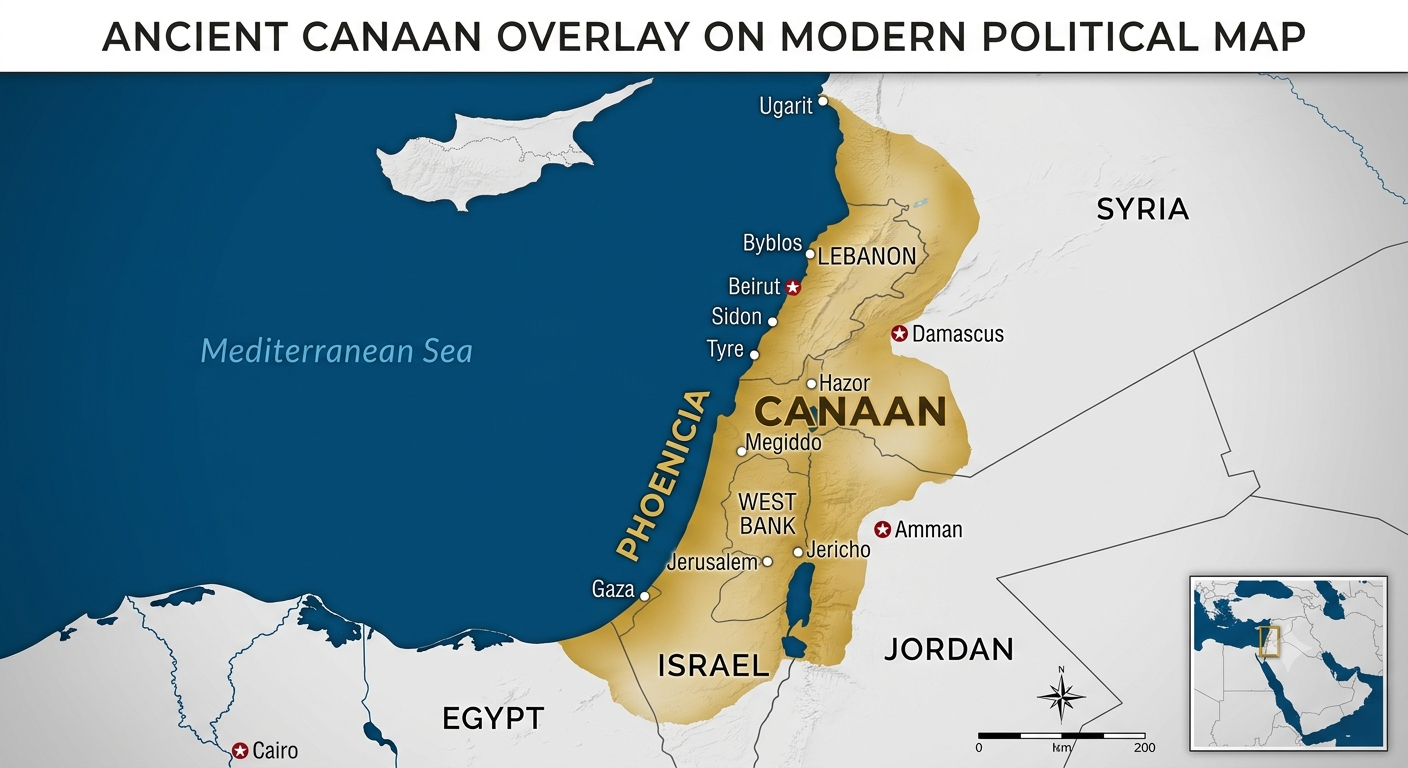
This map shows the territory known as “Canaan” in the Bible. Included are the modern names of geopolitical states.
Canaan itself was compact, closer in size to the state of Vermont than to a regional empire. Its outsized influence on history came from its port cities and trade networks, not its territorial footprint.
Who Were the Canaanites?
The Bible presents the Canaanites as a collection of related peoples rather than a single unified nation. Genesis 10:15–18 lists Sidon, Heth, and the Jebusites, Amorites, Girgashites, Hivites, Arkites, Sinites, Arvadites, Zemarites, and Hamathites as Canaan's descendants. This is essentially a roster of the city-states and tribal groups occupying the land before Israel's arrival.
During the Bronze Age (c. 3300–1200 BCE), this network of independent city-states shared a common language family, a common alphabet tradition, and overlapped in religious practices centered on deities like Baal and Asherah, both of which Scripture repeatedly warns Israel against adopting. Centuries later, during the mid-9th century BCE, the prophet Elijah spoke against the adoption of these foreign gods, which were being spread by the wayward King Ahab and Queen Jezebel (c. 874–853 BCE).
By the time of the Israelite monarchy, the coastal Canaanite city-states were increasingly known by a different name: Phoenician. Tyre and Sidon, the two cities most associated with the Canaanite woman of Matthew 15, are the same cities Greek writers later called Phoenicia. It’s important to realize that the Canaanites didn't disappear so much as continue under a new label, trading across the Mediterranean and eventually giving the world its first true alphabet.
Are There Descendants of the Canaanites Today?
This is one of the more remarkable findings in recent biblical archaeology. In 2017, a team from the Wellcome Trust Sanger Institute sequenced whole genomes from five 3,700-year-old skeletons excavated at Sidon and compared them against the DNA of 99 present-day Lebanese individuals. The results, published in The American Journal of Human Genetics, found that more than 90 percent of the genetic ancestry of modern Lebanese populations traces directly back to the ancient Canaanites, with only a small later admixture from other populations arriving between roughly 2,200 and 3,800 years ago.
In other words, despite thousands of years of conquest, migration, and empire in the region, the Canaanites were never wiped out. Their descendants are, by direct genetic evidence, alive in Lebanon today.
Where Canaan and Canaanites Appear in Scripture
Rather than list every occurrence (the word appears well over a hundred times, mostly in repeated boundary or genealogical formulas), here's a curated table tracing Canaan's role through the biblical narrative:
| Theme | Passage | What It Covers |
|---|---|---|
| Origins | Genesis 9:18–27 | Canaan, son of Ham, and the controversial "curse of Canaan" narrative |
| The Table of Nations | Genesis 10:15–19 | The peoples and cities descended from Canaan; earliest territorial description |
| The Covenant Promise | Genesis 12:5–7; 15:18–21 | God's promise of Canaan's land to Abraham's descendants |
| Warning Against Assimilation | Leviticus 18:24–28; Deuteronomy 7:1–6; 12:29–31 | Israel warned against adopting Canaanite religious practice |
| The Twelve Spies | Numbers 13:1–2, 17–29 | Israel's scouting report on the land and its inhabitants before entry |
| The Conquest | Joshua 3; 11:16–23 | Crossing the Jordan into Canaan; summary of the land taken |
| Incomplete Conquest | Judges 1:27–36 | The Canaanite populations Israel failed to fully displace |
| New Testament Echo | Matthew 15:21–28 | The only direct New Testament encounter — Jesus and the Canaanite woman |
| New Testament Recap | Acts 7:11; 13:19 | Stephen and Paul both briefly recall the conquest of Canaan in sermons to Jewish audiences |
After the Old Testament's heavy use of the term "Canaan" nearly vanishes from the New Testament. Matthew's account of the Canaanite woman is the only place a Canaanite actually appears as a character in the Gospels, making that encounter a rare direct link between the ancient land and the New Testament story.
How This Relates to the Promised Land
It's worth being precise about the difference between "Canaan" and "the Promised Land," since the terms overlap but aren't identical. Canaan is the land as it existed before Israel's arrival. "The Promised Land" is the theological name for that same territory once God attaches a covenant to it. Our Promised Land Map covers that covenantal story in depth.
This page is the other half of that picture: not the promise, but the land and people the promise was made about, where they actually lived, and where their descendants live still.
