Where Is the Ark of the Covenant Today? History, Theories, and Biblical Meaning
Quick Summary
The Ark of the Covenant was a gold-covered wooden chest that stood at the center of Israel’s worship. According to the Old Testament, it represented God’s presence, held the tablets of the Ten Commandments, and traveled with Israel from Sinai to the Temple in Jerusalem. Its dimensions (about 2.5 by 1.5 by 1.5 cubits)were carefully prescribed in Exodus, and its role shaped Israel’s identity, imagination, and theology. The Ark has fascinated archaeologists, scholars, and the public for centuries, especially because where is the ark of the covenant today remains one of history’s greatest unsolved mysteries.
Introduction
Few biblical objects capture the imagination quite like the Ark of the Covenant. In the bible, the ark is presented as a sign of God’s closeness, was carried into battles, placed in holy spaces, and woven into Israel’s understanding of their relationship with God. It’s construction was meant to communicate dignity and reverence and demanded the best of the skilled workers.
Readers throughout the centuries have wondered where it is, what happened to it, and why it mattered so deeply. Archaeologists have searched for clues. Historians have studied the traditions. Scripture itself gives only part of the story, leaving the rest to the realm of mystery and faith.
This article looks at the Ark’s dimensions, its function, its theological depth, and what scholars and archaeologists have said about its fate.
Dimensions of the Ark of the Covenant
Exodus 25:10–22 offers the clearest description of the Ark’s size and construction. Its measurements were given directly to Moses during Israel’s time in the wilderness, and they reflect careful design rather than symbolic approximation. (Read What is a Cubit?)
Size
The Ark was to be:
Two and a half cubits long
One and a half cubits wide
One and a half cubits high
Using the standard cubit of roughly 18 inches, the Ark measured about 45 inches long, 27 inches wide, and 27 inches tall. Some scholars suggest a larger royal cubit (about 20.4 inches), which would expand the dimensions slightly. Either way, the Ark was modest in size—large enough to be imposing, small enough to be carried.
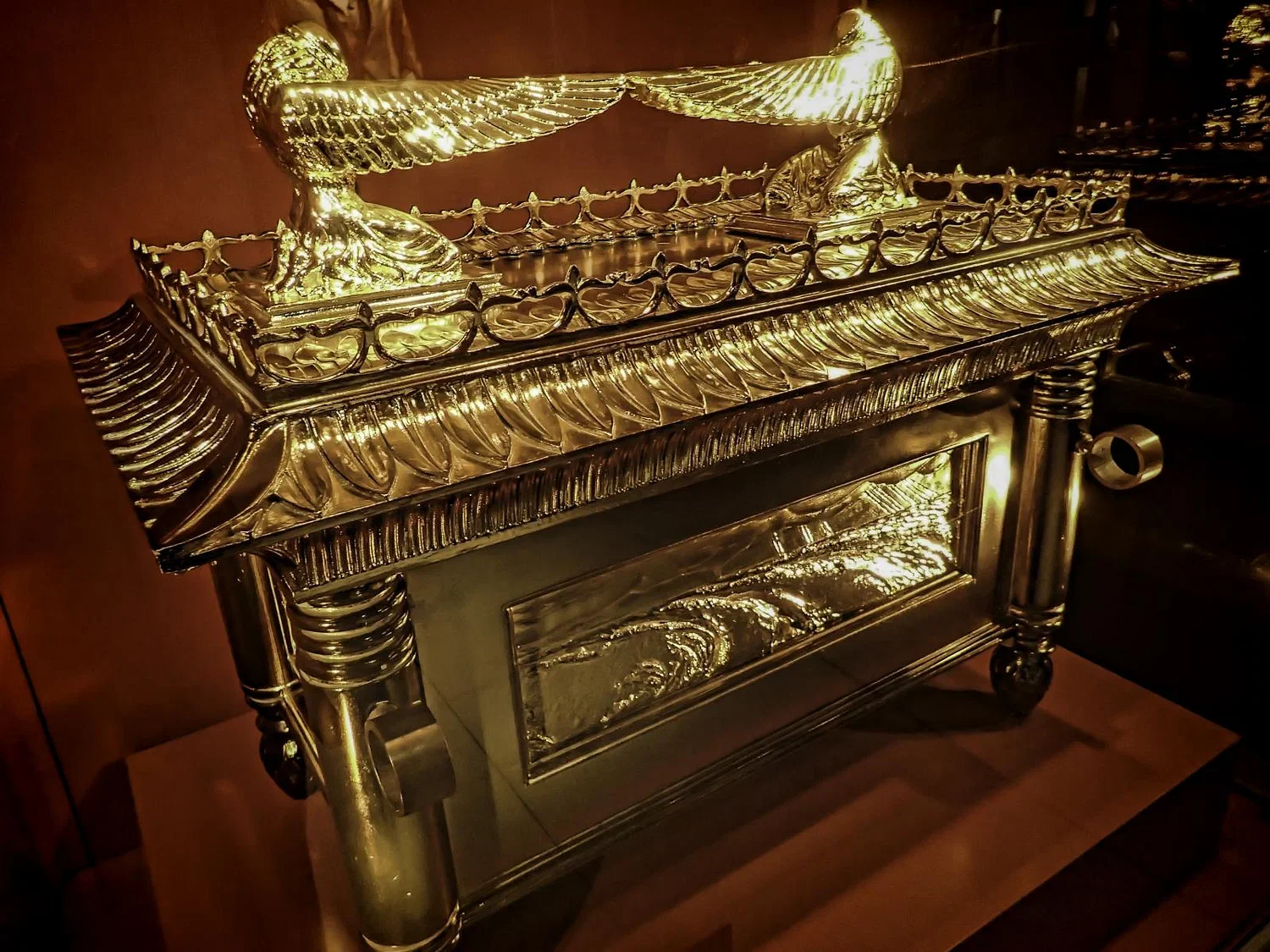
A recreation of the Ark of the Covenant shows it’s unique design and gold overlays. Source.
Construction
The biblical instructions are precise:
Made of acacia wood, a durable desert hardwood.
Covered inside and out with pure gold.
Equipped with four gold rings at the corners.
Designed to be carried with acacia poles overlaid with gold, which were never to be removed.
The lid, called the mercy seat or atonement cover, was also made of pure gold and featured two cherubim facing one another. The space between them was described as the place where God would speak to Moses.
Ark of the Covenant at a Glance
| Feature / Detail | Biblical Specification & Historical Detail |
|---|---|
| Primary Names | Ark of the Covenant, Ark of the Testimony, Ark of God |
| Dimensions | 2.5 cubits long, 1.5 cubits wide, and 1.5 cubits high (approx. 45" × 27" × 27" using an 18-inch cubit) |
| Materials | Constructed of durable acacia wood and overlaid entirely with pure gold inside and out |
| Key Components | Equipped with four gold rings at the corners, carrying poles of acacia wood overlaid with gold (never to be removed), and a solid gold lid known as the mercy seat featuring two facing cherubim |
| Original Contents |
|
| Final Contents | By Solomon’s time (1 Kings 8:9), only the stone tablets remained inside the Ark |
| Chief Builders | Crafted by Bezalel and the skilled artisans of Israel under Moses' direction (Exodus) |
| Primary Roles | Guided Israel's wilderness journeys, parted the Jordan River, circled Jericho, and sat in the Holy of Holies |
| Current Location | Unknown; major historical theories point to hiding before Babylon's destruction, transport to Babylon, or preservation in Axum, Ethiopia |
What Was Inside the Ark of the Covenant?
Hebrews 9:4 and other Old Testament passages list the contents of the Ark at various points in Israel’s history:
The tablets of the Ten Commandments (most consistently mentioned)
A jar of manna (symbol of God’s provision)
Aaron’s budding staff (sign of God’s chosen leadership)
By Solomon’s time, according to 1 Kings 8:9, only the stone tablets remained in the Ark. Still, the association with manna and Aaron’s staff remained part of Israel’s memory. For a complete breakdown of these items, read our deep dive on What Was Inside the Ark of the Covenant?.
The Ark’s Role in Israel’s Story
In the Wilderness: The Ark led Israel’s journeys (Numbers 10:33), symbolizing God’s guidance. When it rested, the camp rested. When it moved, the camp followed. It was kept behind the veil in the tabernacle’s Holy of Holies.
Crossing the Jordan: Joshua 3–4 records that the priests carrying the Ark stepped into the water, and the river stopped flowing. The Ark stood in the middle of the riverbed until the nation crossed.
The Battle of Jericho: The Ark circled Jericho with the priests and the people (Joshua 6), emphasizing that victory did not come from military strength but from God’s presence.
Captured and Returned: In 1 Samuel 4–6, the Philistines captured the Ark but quickly returned it after calamity struck their cities. The famous episode with Dagon toppling before the Ark (1 Samuel 5) reinforced that Israel’s God could not be captured in spirit even if the symbol of his presence had been seized.
In Solomon’s Temple: The Ark was placed in the Holy of Holies when the Temple was completed (1 Kings 8). It remained the sacred center of Israel’s worship until the Babylonian destruction.
What Happened to the Ark? (Theories on Where It Is Today)
The question of where is the ark of the covenant today remains one of Scripture’s enduring mysteries. Several primary theories exist, drawn from archaeology, ancient texts, and later traditions:
1. Hidden Before the Babylonian Invasion
Some Jewish traditions claim priests hid the Ark before Babylon’s destruction of the Temple in 587 BCE. The Mishnah (Shekalim 6:1) hints that a hidden chamber beneath the Temple may have served this purpose. Archaeologists cannot verify this due to the sensitivities of Temple Mount excavation.
2. Carried to Babylon
A minority of scholars believe the Ark may have been taken to Babylon, though it is not listed among the objects Nebuchadnezzar seized (2 Kings 25; Jeremiah 52). Its absence from those inventories is one reason most dismiss this view.
3. Taken to Ethiopia
The Ethiopian Orthodox Church maintains a centuries-old tradition that the Ark resides in Axum, guarded in a chapel by a single appointed monk. Subject matter experts generally treat this as a treasured tradition rather than a verifiable historical claim. Scholars like Edward Ullendorff, who studied Ethiopian legends, have noted the devotion behind the claim while acknowledging the difficulty of confirming it.
4. Lost During the Temple’s Fall
Some archaeologists propose that the Ark may have been destroyed when Babylon razed the Temple. Since the Holy of Holies was the most protected space, this is possible but not certain. The absence of evidence leaves room for debate.
5. Jeremiah’s Prophetic Vision
Jeremiah 3:16 imagines a future when people will no longer speak of or seek the Ark. Whether symbolic or descriptive, it suggests that the Ark’s disappearance may have served a spiritual purpose in the unfolding biblical story.
The Ark’s Meaning
The Ark embodies several central themes in Scripture:
God’s Nearness: The Ark was not magic. It was relational. It signified that God traveled with the people, dwelled among them, and called them to faithfulness.
Covenant: Inside the Ark lay the reminders of God’s commands, provision, and calling. It was a container of memory.
Holiness: Only the priests could approach it. Only with reverence could it be transported. It was a physical reminder that God’s presence is not casual.
Mercy and Atonement: The mercy seat played a part in the Day of Atonement liturgy. Later Christian readers saw echoes of this in Christ’s reconciling work.
FAQs About the Ark of the Covenant
Where is the Ark of the Covenant today?
Its location is unknown. Traditions point to Ethiopia, the Temple Mount, or Babylon, but no firm archaeological evidence has confirmed any site.
Who built the Ark?
Exodus attributes the craftsmanship to Bezalel and the skilled artisans of Israel, working under Moses’ direction.
What did the Ark symbolize?
It symbolizes God’s presence, covenant, holiness, and mercy.
See Also
Works ConsultedThe Bible: The Holy Bible, English Standard Version (ESV). Crossway Bibles, 2001. (Specifically referencing Exodus 16, 25; Numbers 10, 17; Deuteronomy 10; Joshua 3–6; 1 Samuel 4–6; 1 Kings 8; 2 Kings 25; Jeremiah 3, 52; Hebrews 9).
The Mishnah: The Mishnah: Translated from the Hebrew with Introduction and Brief Notes by Herbert Danby. Oxford University Press, 1933. (Specifically referencing Shekalim 6:1).
Scholarship & Commentary: Ullendorff, Edward. Ethiopia and the Bible. Oxford University Press for the British Academy, 1968.
