Mark 9 Summary, Outline, and Meaning
Part of the Gospel of Mark Bible study.
Mark 9 Summary
In Mark 9, Jesus is transfigured in glory on a mountain, then comes down into a world of need, failure, and confusion. The contrast is stark. Peter, James, and John see him shine with Moses and Elijah and hear God's voice: "This is my Son, the Beloved; listen to him!" At the foot of the mountain, a desperate father brings a boy the disciples couldn't help, and cries, "I believe; help my unbelief!" Jesus predicts his death a second time, but the disciples argue about who is the greatest, so Jesus places a child among them. The chapter ends with sharp warnings about causing others to stumble and a call to "be at peace with one another."
Mark 9 at a Glance
| Verses | What happens | The lesson |
|---|---|---|
| 9:1–8 | The Transfiguration | Jesus is the beloved Son: listen to him |
| 9:9–13 | Coming down: questions about Elijah | Glory comes through suffering |
| 9:14–29 | A boy healed; "help my unbelief" | Faith that is honest about its doubt |
| 9:30–32 | Second Passion prediction | The disciples still don't understand |
| 9:33–37 | Who is the greatest? A child in their midst | The first must be last and servant of all |
| 9:38–41 | A stranger casting out demons | "Whoever is not against us is for us" |
| 9:42–50 | Stumbling blocks, millstones, and salt | Take sin seriously; live at peace |
Mark 9 Outline
A promise of the kingdom (9:1)
The Transfiguration (9:2-8)
The question about Elijah (9:9-13)
Jesus heals a boy with an unclean spirit (9:14-29)
Jesus again predicts his death and resurrection (9:30-32)
Who is the greatest? (9:33-37)
The outsider who cast out demons (9:38-41)
Temptations to sin (9:42-50)
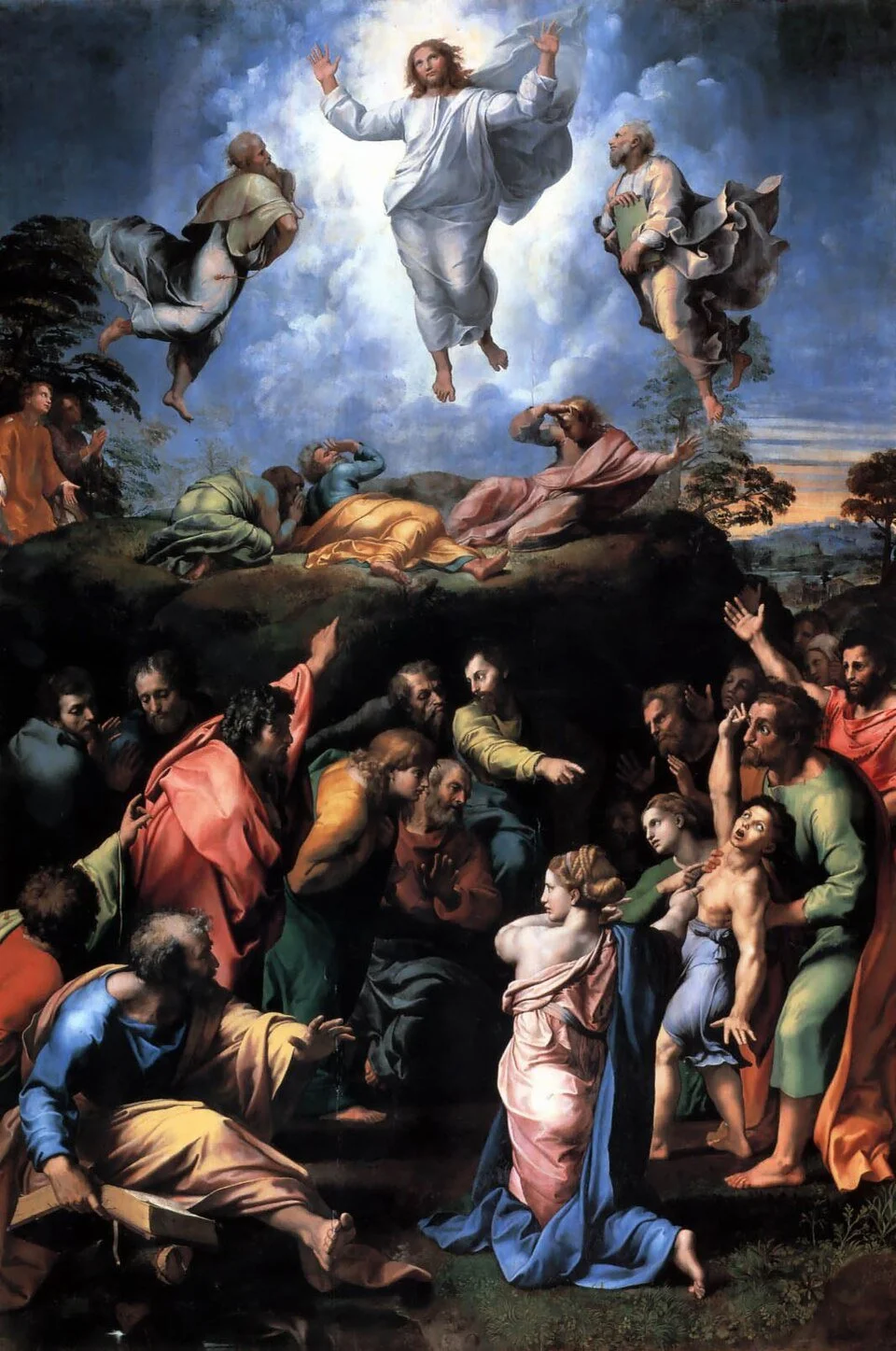
The Transfiguration by Rafael. This is part of the Faith in Art Series on www.pastorjasonelder.com The artist depicts the scene so effectively; divine glory and revelation above with human need and agony below. Read more about Rafael’s painting, The Transfiguration, here.
The Big Picture: On the Way to the Cross
Mark 9 sits in the middle of the section of Mark often called "the Way" (8:22-10:52). You can see a visual of the structure of this gospel on the Gospel of Mark hub page here. Jesus has left the crowds of Galilee behind and is heading toward Jerusalem. Along the road, he teaches his disciples what it means that he is the Messiah, and what it will cost to follow him. The section opens and closes with two blind men receiving their sight, at Bethsaida (8:22-26) and at Jericho (10:46-52), a frame that gently suggests the disciples need their eyes opened too. Scholars call this kind of frame an inclusio. And the first healing happens in two stages, a picture of disciples who see Jesus only partly until the road to the cross clears their sight.
Just before Mark 9, Peter confesses that Jesus is the Messiah (8:29), and Jesus immediately says the Son of Man must suffer, be killed, and rise again. Peter rebukes him. Jesus rebukes Peter. And Jesus calls everyone to "take up their cross and follow me" (8:34).
That pattern repeats three times in this section, and Mark 9 holds the second round. We see this at work when we place them side by side.
| First | Second | Third | |
|---|---|---|---|
| Where | Mark 8:31 | Mark 9:31 | Mark 10:33–34 |
| What Jesus says | He will suffer, be rejected, be killed, and rise | He will be betrayed into human hands, killed, and rise | He will be handed over, mocked, flogged, killed, and rise |
| How the disciples respond | Peter rebukes Jesus | They argue about who is greatest | James and John ask for the best seats |
| What Jesus teaches | Deny yourself and take up your cross | The first must be last and servant of all | The Son of Man came to serve and give his life |
Every time Jesus talks about the cross, the disciples talk about status. And every time, Jesus patiently teaches them again. It's a mirror for any of us who want the glory without the way of the cross. For the third round, see The Rich Young Ruler (Mark 10:17-31) and Blind Bartimaeus (Mark 10:46-52).
Mark 9:1-8: The Transfiguration
The chapter opens with a promise: "There are some standing here who will not taste death until they see that the kingdom of God has come with power" (9:1). Six days later, three of them get a glimpse.
"Six days later, Jesus took with him Peter and James and John, and led them up a high mountain apart, by themselves. And he was transfigured before them, and his clothes became dazzling white, such as no one on earth could bleach them. And there appeared to them Elijah with Moses, who were talking with Jesus." (Mark 9:2-4)
The word transfigured translates the Greek metamorphoo, the root of our "metamorphosis." For a moment, the disciples see who Jesus really is. Mark's homey detail, clothes whiter than any launderer could get them, tells us this light didn't come from earth. It’s important to note this: Jesus did not become something he wasn’t already. His divine nature, who he is, is being revealed more and more. It’s not a change so much as a revelation, which, I think, is Mark’s point: in order for us to be faithful followers of Jesus, we must not see him as a hard teacher, someone to be argued with, but someone who is our Messiah and Lord, and should be trusted and followed.
Why Moses and Elijah? Moses gave the Law, and Elijah stood for the prophets. Both met God on a mountain (Exodus 24; 1 Kings 19). Both had unusual departures from this life. Together they represent all of Israel's Scriptures, and both are talking with Jesus. See Who Was Elijah in the Bible?
Peter, overwhelmed, blurts out an offer to build three "dwellings," or shelters. Mark adds, kindly, "He did not know what to say, for they were terrified" (9:6). Maybe Peter wanted to make the moment last. But Jesus isn't staying on the mountain.
Then a cloud, the sign of God's presence since the days of the Exodus, covers them, and a voice speaks:
"This is my Son, the Beloved; listen to him!" (Mark 9:7)
The same voice spoke at Jesus' baptism (1:11). This time it adds a command: listen to him. Listen especially, it seems, to what he has just been saying about the cross. Then, suddenly, they see no one but Jesus.
Mark 9:9-13: Coming Down the Mountain
On the way down, Jesus tells them to say nothing "until after the Son of Man had risen from the dead" (9:9). The glory they saw can only be understood in light of the cross and the resurrection.
The disciples ask about a puzzle. The scribes taught that Elijah must come first, before the Messiah (Malachi 4:5). Jesus answers that Elijah has already come, "and they did to him whatever they pleased" (9:13). He means John the Baptist, who was arrested and beheaded (6:14-29). Elijah's forerunner suffered, and the Son of Man will too. See The Beginning of the Good News (Mark 1:1-8).
Mark 9:14-29: "I Believe; Help My Unbelief!"
From the glory of the mountain, Jesus walks straight into chaos. A crowd is arguing. A father has brought his son, who is tormented by a spirit that throws him into fire and water and leaves him unable to speak. The other disciples tried to help and couldn't.
Jesus sighs, "You faithless generation, how much longer must I be among you?" (9:19). Then he asks the father how long this has been happening. "From childhood," the father says, and then he speaks the words of every exhausted parent: "If you are able to do anything, have pity on us and help us." (Mark 9:22) This is an echo of the Syrophoenician Woman, as she, like most parents, will do anything for their child.
Jesus catches the word if. "If you are able! All things can be done for the one who believes" (9:23). And the father answers with one of the most honest prayers in the Bible: "Immediately the father of the child cried out, 'I believe; help my unbelief!'" (Mark 9:24)
He doesn't pretend to have perfect faith. He brings the faith he has, mixed with doubt, and asks Jesus to make up the difference. And Jesus does. He commands the spirit to leave, takes the boy by the hand, and lifts him up.
Later, the disciples ask privately why they couldn't do it. Jesus answers, "This kind can come out only through prayer" (9:29). Perhaps they had begun to treat their earlier success (6:13) as a technique. Real power comes from dependence on God, not from method.
For more on the healing stories in Mark, see How Many Miracles in Mark? and What Is Faith in the Bible?
Pastor's Heads Up. Over the past 11 years, I’ve preached through the Gospel of Mark 3 times. This story always evokes conversation. We all want to be someone who can make a positive impact on others. Like the disciples, we try to fix things as best as we can, and yet, sometimes to no avail. As much as our desires are earnest and as real the needs around us, we must not forget to ground our lives and our efforts in deep connection with God through prayer. Prayer and Fasting are disciplines that can lead us into a closer walk with God. These disciplines have grounded our fellow Christians for over 2,000 years and we do well to learn from them.
Mark 9:30-32: The Second Passion Prediction
Jesus travels quietly through Galilee because he's teaching his disciples: "The Son of Man is to be betrayed into human hands, and they will kill him, and three days after being killed, he will rise again." (Mark 9:31) Mark adds a painfully honest line: "But they did not understand what he was saying and were afraid to ask him" (9:32). Just after the revelation on the mountaintop, they still do not understand that Jesus’ role as Messiah means the cross.
Mark 9:33-37: Who Is the Greatest?
Back in Capernaum, Jesus asks, "What were you arguing about on the way?" Silence. "For on the way they had argued with one another who was the greatest" (9:34). Jesus had just told them he was going to die. They had been arguing about rank.
Jesus sits down, the posture of a teacher, and calls the twelve: "Whoever wants to be first must be last of all and servant of all." (Mark 9:35) Then he does something unforgettable. He takes a little child, sets the child in the middle of them, and takes the child in his arms: "Whoever welcomes one such child in my name welcomes me, and whoever welcomes me welcomes not me but the one who sent me." (Mark 9:37)
In the ancient world, children had no status, no rights, and nothing to offer anyone climbing the social ladder. Welcoming a child earned you nothing. That's exactly the point. Greatness in God's kingdom looks like making room for those who can't repay you.
You can hear a sermon on this passage in Following Jesus in a Power-Hungry World (Mark 9:30-37), and a short reflection in Who Is the Greatest? A Devotional. See also Bible Verses About Humility and Bible Verses About Children.
Mark 9:38-41: "Whoever Is Not Against Us Is for Us"
John reports proudly that they stopped a man casting out demons in Jesus' name, "because he was not following us" (9:38). The disciples who couldn't heal the boy wanted to stop someone who could.
Jesus says, "Do not stop him... Whoever is not against us is for us" (9:39-40). Even "a cup of water to drink because you bear the name of Christ" will not go unrewarded (9:41). God's work is bigger than our group. Jesus refuses to let his followers turn ministry into a closed club.
This would be like someone stopping funding for a public works project because they were on opposite sides of the political spectrum. Doing right is never wrong, so why stand in the way of something that could help someone else? Rev. Martin Luther King, Jr. said that if your coalition of partners is not complicated, then maybe it’s not big enough. Think of the 12 disciples. One was a former tax collector who worked for the Roman machine, and another was a political zealot who worked to subvert the machine! Yet, Christ calls them together for the kingdom of God, that is, the work of justice and mercy on the earth.
Mark 9:42-50: Stumbling Blocks and Salt
Then Jesus' tone turns serious. "If any of you put a stumbling block before one of these little ones who believe in me, it would be better for you if a great millstone were hung around your neck and you were thrown into the sea" (9:42). The "little ones" include the child he just held and every vulnerable believer. Causing them to fall away is grave.
He continues with startling images. If your hand, your foot, or your eye causes you to stumble, cut it off or tear it out, because it's better to enter life maimed than to be thrown into hell, "where their worm never dies, and the fire is never quenched" (9:48, quoting Isaiah 66:24).
A word of caution. Jesus is using deliberate exaggeration, a common teaching style in his day. He is not commanding anyone to harm their body. His point is urgency: deal decisively with whatever leads you or others into sin, even when it costs you something you value. The word translated "hell" here is Gehenna, the valley outside Jerusalem associated with the worst idolatry in Israel's history, which became an image of final judgment. See How Many Times Is Hell Mentioned in the Bible?
The chapter ends with salt. "For everyone will be salted with fire" (9:49), likely meaning that every disciple will be tested and purified through hardship. And then a final word that ties the chapter together: "Have salt in yourselves, and be at peace with one another" (9:50). The disciples began this section arguing about who was greatest. Jesus ends it calling them to peace.
Mark 9 in Matthew and Luke
The main stories of Mark 9 appear in the other Synoptic Gospels: the Transfiguration (Matthew 17:1-8; Luke 9:28-36), the healing of the boy (Matthew 17:14-20; Luke 9:37-43), the second Passion prediction (Matthew 17:22-23; Luke 9:43-45), and the argument about greatness (Matthew 18:1-5; Luke 9:46-48). Luke alone says Moses and Elijah spoke with Jesus about his "departure," literally his exodus, which he was about to accomplish in Jerusalem (Luke 9:31). Only Mark records the father's cry, "I believe; help my unbelief!"
Mark 9 Meaning for Today
Listen to him. The one command God speaks from the cloud is simple. When Jesus' words about the cross are hard to hear, those are the words we most need to listen to.
Mountaintops don't last. Like Peter, we'd like to build shelters and stay where faith feels bright. But Jesus leads us back down into the valley, where people are hurting and help is needed.
Honest faith is real faith. "I believe; help my unbelief" is not a weak prayer. It's one of the most faithful prayers in Scripture.
Greatness looks small. In God's kingdom, the great are those who welcome people who can offer nothing in return.
God's work is bigger than our group. Jesus refuses to let his followers become territorial about ministry.
Mark 9 in the Lectionary
In Year B of the Revised Common Lectionary, the year of Mark, this chapter supplies three Sunday Gospel readings. For worship resources, see Year B Liturgies and All Sermons from Mark.
Sermon angles
Listen to Him: the one command from the mountain
Down the Mountain: from glory to the valley of need
I Believe; Help My Unbelief: faith that tells the truth
A Child in the Middle: what greatness looks like in God's kingdom
Small-group questions
Have you had a "mountaintop" experience of faith? What happened when you came back down?
Where in your life would you pray, "I believe; help my unbelief"?
Why do you think the disciples kept arguing about greatness?
Who are the "children," the people with no status, whom your church could welcome more fully?
Mark 9 FAQ
What is the main message of Mark 9? Jesus is the beloved Son of God, revealed in glory, yet his path leads through suffering. True discipleship means listening to him, trusting him honestly, and becoming servants of all.
What happened at the Transfiguration? On a high mountain, Jesus' appearance changed and his clothes became dazzling white. Moses and Elijah appeared and talked with him, and God's voice said, "This is my Son, the Beloved; listen to him!" (Mark 9:2-8).
Why did Moses and Elijah appear with Jesus? They represent the Law and the Prophets, the whole of Israel's Scriptures. Their presence shows that Jesus fulfills everything God had promised through them.
What does "I believe; help my unbelief" mean? It's the honest prayer of a father who has faith but also doubt. Jesus doesn't reject him. He heals his son, showing that God welcomes imperfect faith that turns to him for help.
Why couldn't the disciples cast out the demon? Jesus says, "This kind can come out only through prayer" (9:29). Their failure pointed to a lack of dependence on God, not a missing technique.
Does Jesus really mean to cut off your hand in Mark 9? No. He uses exaggeration to show how seriously we should take sin. The point is to remove whatever leads us or others away from God, not to harm the body.
Keep Studying
Scripture quotations are from the New Revised Standard Version.
