The Golden Calf in the Bible: Story, Meaning, and Why It Happened
Quick Summary
The story of the golden calf in Exodus 32 stands as one of Israel’s most sobering moments, a moment when fear, impatience, and longing for something tangible pulled the people away from trust in God. This article explains what the calf was, why it was made, how the people worshiped it, and how Moses responded. The story also reveals deeper themes of human longing, misplaced trust, divine mercy, and the patient work of restoration.
Introduction
Some stories in Scripture sit heavy on the heart, not because they are obscure but because they feel close to home. The golden calf is one of those stories. Israel had just been delivered through the sea, fed with manna, given water in the wilderness, and invited into covenant. Moses was on the mountain receiving the commandments, learning how this rescued people would live with God. Yet down below, everything unraveled.
The people asked Aaron to make an image for them. They wanted something to lead them, something they could see. Aaron fashioned a calf out of gold, shaped by a graving tool. A festival followed, complete with sacrifices, shouting, and dancing. What happened next shaped Israel’s understanding of sin, intercession, and grace for generations.
This article explores the story itself, the meaning of the golden calf, and why it happened in the first place, linking the account to Scripture’s wider themes and Israel’s ongoing struggle with idolatry.
The Story of the Golden Calf (Exodus 32)
The story unfolds while Moses is on Mount Sinai for forty days and nights—a detail that echoes themes found in the Ten Commandments tablets narrative and other covenant moments. for forty days and nights. The absence feels like abandonment to the people below. They approach Aaron and say, “Make gods for us, who shall go before us.” Moses had led them out of Egypt, but in his absence, they reach for what is familiar, something visible, manageable, like the religious images common in Egypt and Canaan.
Aaron gathers gold earrings from the people, melts them, and forms a calf. This stands in sharp contrast to the crafting of sacred objects like the Ark of the Covenant or the Tabernacle, which were made according to God’s instruction., melts them, and forms a calf. Calf imagery was common in the ancient Near East, appearing in cultures surrounding Israel and later reappearing in the northern kingdom’s worship practices, much like Jeroboam’s later golden calves which echoed this earlier failure., symbolizing strength, vitality, and fertility. The people declare, “These are your gods, O Israel, who brought you up out of the land of Egypt!” A festival follows. Sacrifices are offered. The celebration grows loud.
When Moses descends the mountain with the tablets of the covenant—tablets described earlier in Exodus and explored further in discussions of the Ten Commandments tablets., he sees the calf and the dancing. In sorrow and anger, he throws the tablets down, breaking them. The image is vivid—Israel broke the covenant, and the shattered tablets embody that breach. Moses destroys the calf, grinds it into powder, scatters it upon the water, and makes the people drink.
Judgment follows. The tribe of Levi stands with Moses against the rebellion, and the text records that many died. Yet the story does not end in devastation. Moses intercedes for the people. God declares both justice and mercy, promising to be present but also to discipline. The covenant will continue.
What the Golden Calf Represented
The golden calf was more than a physical image. It symbolized Israel’s struggle with trust. The people wanted something to guide them, something they could see. Moses was gone, the mountain was wrapped in cloud, and the God who spoke from fire felt far away.
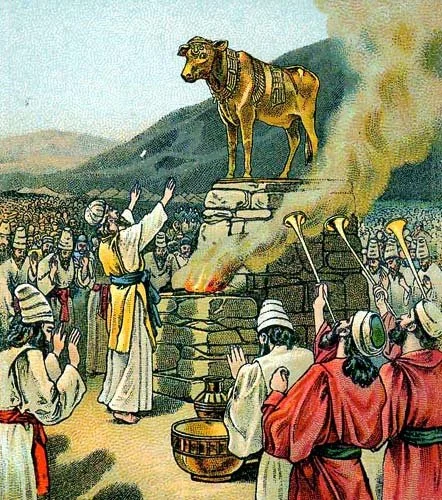
This is a Bible card published in 1901 by the Providence Lithograph Company. Source.
Familiarity in the wilderness
Israel reached for forms they knew—shapes familiar from Egypt, where visible images stood in stark contrast to the invisible God who met them in the wilderness sanctuary and guided them by fire and cloud in the Tabernacle.. In Egypt and Canaan, bovine images were common symbols of divine power. Even if Israel did not believe the calf itself was a god, they may have believed it represented God’s strength. But any attempt to portray the invisible God through an image diminishes who God is.
Control instead of trust
An image can be shaped, touched, and managed. It gives the illusion of control. God, however, cannot be molded by human hands or expectations.
Impatience and fear
The people did not turn to idolatry because they forgot God. They turned because they feared being abandoned. Their impatience became a doorway.
Why Aaron Made the Golden Calf
Scripture offers no full justification from Aaron. When confronted by Moses, he deflects, saying the people pressured him and that the calf “came out” of the fire. Yet the text is clear—Aaron shaped it deliberately.
Aaron’s role reveals the vulnerability of leadership. He feared losing the people. He chose to appease rather than guide. His decision reminds leaders in every age that fear can distort judgment.
The People’s Worship
After the calf was made, Aaron built an altar before it and proclaimed a festival to the Lord. This suggests the people may have viewed the calf not as a replacement god but as a representation of the God who saved them. The problem, however, remains: God had already forbidden images.
The celebration grew chaotic. The Hebrew phrase often translated “revelry” suggests looseness—things out of control. What began as a misguided attempt at worship slid into something else entirely.
Consequences and Mercy
When Moses saw the calf and the dancing, he broke the tablets. It was a symbolic act. God’s covenant was fractured by the people’s actions.
Moses then turned to God in intercession. His prayer stands as one of Scripture’s most powerful moments. He pleads for mercy. He appeals to God’s promises. He asks God to remember Abraham, Isaac, and Jacob. God listens.
Justice was still carried out, and many died in the aftermath. Yet the larger story is mercy. God renews the covenant, gives Moses new tablets, and continues to lead the people.
Later Reflections on the Golden Calf
The golden calf became a lasting symbol of misplaced trust. Later prophets referred back to it when calling the people to faithfulness. Centuries after the event, Jeroboam created two golden calves in the northern kingdom, repeating the same error and setting a pattern of unfaithfulness.
The calf became a shorthand warning—when trust grows thin, people often reach for what they can shape rather than the God who shapes them.
Why This Story Still Matters
The golden calf is not simply a warning about ancient idols. It speaks to the human heart. Idols today may not be made of gold, but they still form when fear twists into control or when impatience replaces trust.
The story invites reflection:
Where do we reach for something visible when God feels distant?
What do we shape with our own hands to feel more secure?
How do leaders respond when a community drifts toward fear?
The story also points to the grace that holds the people together. Moses intercedes. God listens. The covenant is renewed.

