What is the Oldest Manuscript of the Bible?
Quick Summary
The oldest surviving manuscripts of the Bible are not complete Bibles but fragments and collections of texts preserved on papyrus, parchment, and scrolls. For the Old Testament, the Dead Sea Scrolls, dating from roughly the third century BCE to the first century CE, are the earliest known manuscripts. For the New Testament, the oldest manuscripts are papyrus fragments from the early second century CE. Together, these manuscripts provide crucial evidence for how the biblical texts were transmitted, preserved, and copied over time.
Introduction
When people ask about the oldest manuscript of the Bible, they often imagine a single ancient book preserved intact from antiquity. In reality, the Bible reached its present form through centuries of copying, collecting, and preservation. No original manuscripts survive for any biblical book. Instead, scholars study thousands of ancient manuscripts, fragments, and translations to understand the earliest recoverable forms of the text.
The question of the oldest manuscript is therefore best approached in parts. The Old Testament and New Testament have different manuscript histories, written materials, and patterns of preservation. Examining these traditions side by side helps clarify how the Bible was transmitted and why modern editions of Scripture are remarkably stable despite their long history.
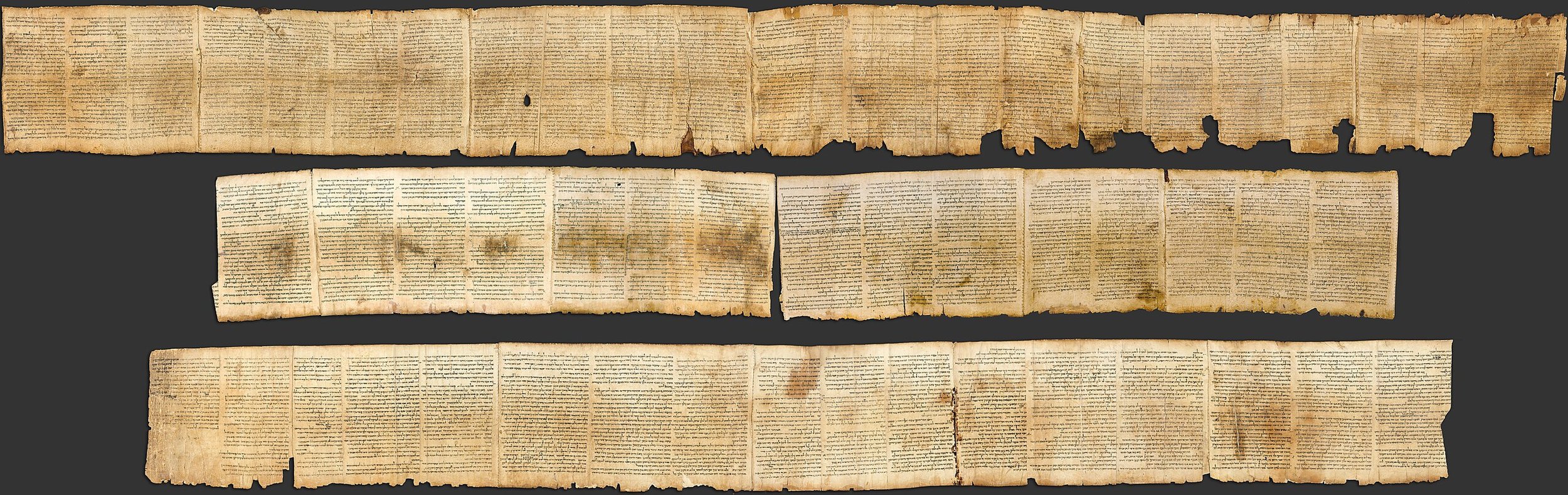
This is the Great Isaiah Scroll and contains almost the entire book of Isaiah. This was found in the discovery of the Dead Sea Scroll. Source
What Scholars Mean by “Manuscript”
A manuscript is a handwritten copy of a text. Before the invention of the printing press, all biblical texts were copied by hand, often by trained scribes working within religious communities. Manuscripts could range from small fragments containing a few verses to large codices containing multiple books.
When scholars speak about the oldest biblical manuscripts, they are referring to the oldest surviving physical copies, not the original compositions. These manuscripts are dated through a combination of paleography, which studies handwriting styles, and archaeological context.
The Old Testament: The Dead Sea Scrolls
The oldest known manuscripts of the Old Testament come from the Dead Sea Scrolls, discovered beginning in 1947 near Qumran by the Dead Sea. These scrolls include fragments and manuscripts of nearly every book of the Hebrew Bible, with the notable exception of Esther.
The Dead Sea Scrolls date from approximately the third century BCE to the first century CE. Among them are copies of biblical books such as Isaiah, Psalms, Deuteronomy, and Genesis. The Great Isaiah Scroll, for example, is a nearly complete copy of the book of Isaiah dating to around the second century BCE.
Before the discovery of the Dead Sea Scrolls, the oldest complete Hebrew manuscripts dated to the medieval period, over a thousand years later. The scrolls demonstrated that the Hebrew text had been transmitted with remarkable consistency across centuries. While variations exist, they are generally minor and do not alter the theological substance of the text.
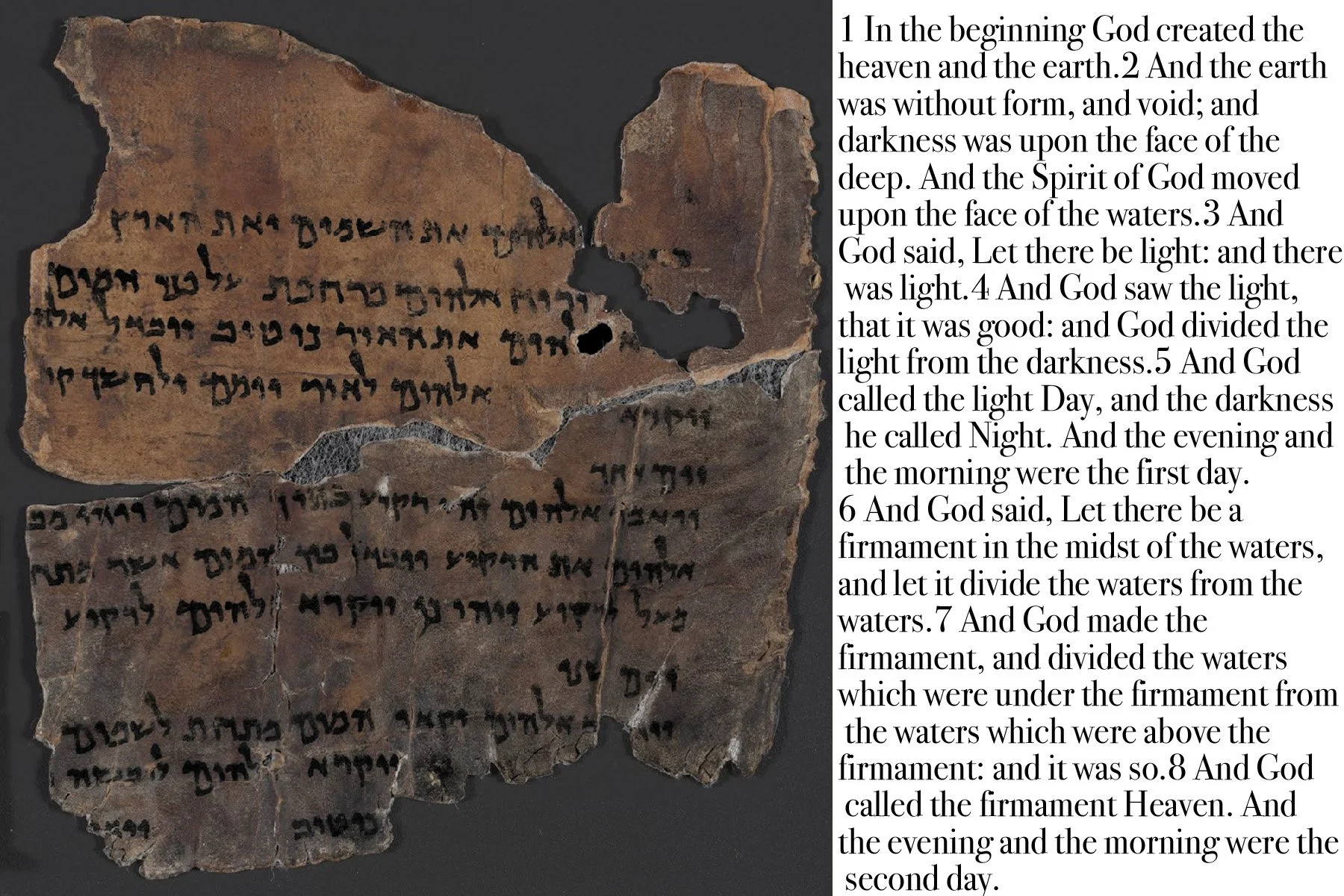
This is a fragment of the Book of Genesis. Source
Other Ancient Hebrew Manuscripts
In addition to the Dead Sea Scrolls, later Hebrew manuscripts such as the Aleppo Codex and the Leningrad Codex play a crucial role in the transmission of the Old Testament. These codices date to the tenth and eleventh centuries CE and represent the Masoretic Text, which became the standard Hebrew text for Jewish communities.
Although these manuscripts are much later than the Dead Sea Scrolls, their close agreement with earlier material underscores the care with which scribes preserved the biblical text.
The New Testament: Early Papyrus Manuscripts
The manuscript history of the New Testament begins with papyrus fragments from the early centuries of Christianity. The oldest widely cited New Testament manuscript is a small fragment known as Papyrus 52, which contains a portion of the Gospel of John and is often dated to the early second century CE.
Other early papyri, such as Papyrus 66 and Papyrus 75, date to the second and early third centuries and preserve substantial portions of the Gospels. These manuscripts demonstrate that the New Testament texts were circulating widely and being copied within decades of their composition.
Unlike the Old Testament, which was preserved primarily within a single religious tradition, the New Testament spread rapidly across diverse communities. This resulted in a large number of manuscripts with small variations, which scholars compare to reconstruct the earliest attainable form of the text.
Codices and the Development of the Bible as a Book
By the fourth century CE, biblical manuscripts increasingly appeared in codex form rather than scrolls. Two of the most famous early Christian codices are Codex Sinaiticus and Codex Vaticanus. These manuscripts contain large portions of the Old and New Testaments and date to the fourth century.
While these codices are not the oldest manuscripts of individual biblical books, they are among the oldest nearly complete collections of Scripture. They provide valuable insight into which books were being read together and how early Christians organized biblical texts.
How Scholars Use Manuscripts
Scholars compare manuscripts to identify copying patterns, scribal habits, and textual variations. This process, known as textual criticism, does not seek to undermine Scripture but to understand how it was transmitted. By comparing thousands of manuscripts, scholars can determine with high confidence what the original texts most likely said.
John J. Collins emphasizes that the existence of multiple manuscript traditions reflects the vitality of biblical transmission rather than uncertainty. Tremper Longman III likewise notes that the abundance of manuscripts strengthens confidence in the text, since differences can be analyzed and evaluated rather than hidden.
Why the Oldest Manuscripts Matter
The oldest biblical manuscripts matter because they anchor the Bible in history. They show that Scripture was written, copied, and preserved within real communities facing real circumstances. These manuscripts also demonstrate continuity, revealing that the Bible read today is deeply connected to the texts read centuries ago.
Rather than threatening faith, the manuscript evidence supports the reliability of the biblical tradition. The gaps between composition and surviving manuscripts are not unusual for ancient texts, and the Bible is better attested than most works from antiquity.
Frequently Asked Questions
Is there an original manuscript of the Bible?
No. The original manuscripts, often called autographs, no longer survive. All existing biblical manuscripts are copies.
What is the single oldest biblical manuscript?
There is no single oldest manuscript of the entire Bible. The Dead Sea Scrolls are the oldest Old Testament manuscripts, and early papyrus fragments are the oldest New Testament manuscripts.
Do manuscript differences change the Bible’s message?
Most differences are minor, such as spelling or word order, and do not affect core beliefs or theology.
Why are there so many manuscripts?
Because the Bible was copied and shared widely across centuries, resulting in a large and diverse manuscript tradition.
Sources and Further Reading
Collins, John J. Introduction to the Hebrew Bible. 3rd ed. Fortress Press, 2018, pp. 63–75.
Longman III, Tremper. An Introduction to the Old Testament. 2nd ed. Zondervan, 2006, pp. 69–84.

