What Precious Stones are Mentioned in the Bible?
Quick Summary
The Bible mentions a wide range of precious stones, from jasper and sapphire to emerald, beryl, and amethyst. These stones appear in moments of worship, judgment, beauty, and hope. They are found on the high priest’s breastplate, in prophetic visions, and in the foundations of the New Jerusalem. Each stone carries symbolic meaning, reflecting God’s glory, the unity of Israel, and the promise of restoration.
Introduction
Precious stones appear in the Bible in moments where language alone seems too small. When the writers describe God’s presence, heavenly visions, or the beauty of creation, they turn to the brightness of stones. These gems were known in the ancient world for their color, cost, and rarity. Yet the biblical writers use them for more than adornment. The stones point toward God’s light, God’s covenant, and God’s care for the people.
The Bible speaks of stones in several settings. Some appear in the earliest chapters when describing Eden. Some appear in the clothing of Israel’s high priest. Others shine in prophetic visions of God’s throne or in the final chapters of Revelation. This variety shows that precious stones were woven into the imagination of Israel. They stood for truth, beauty, and the nearness of God.
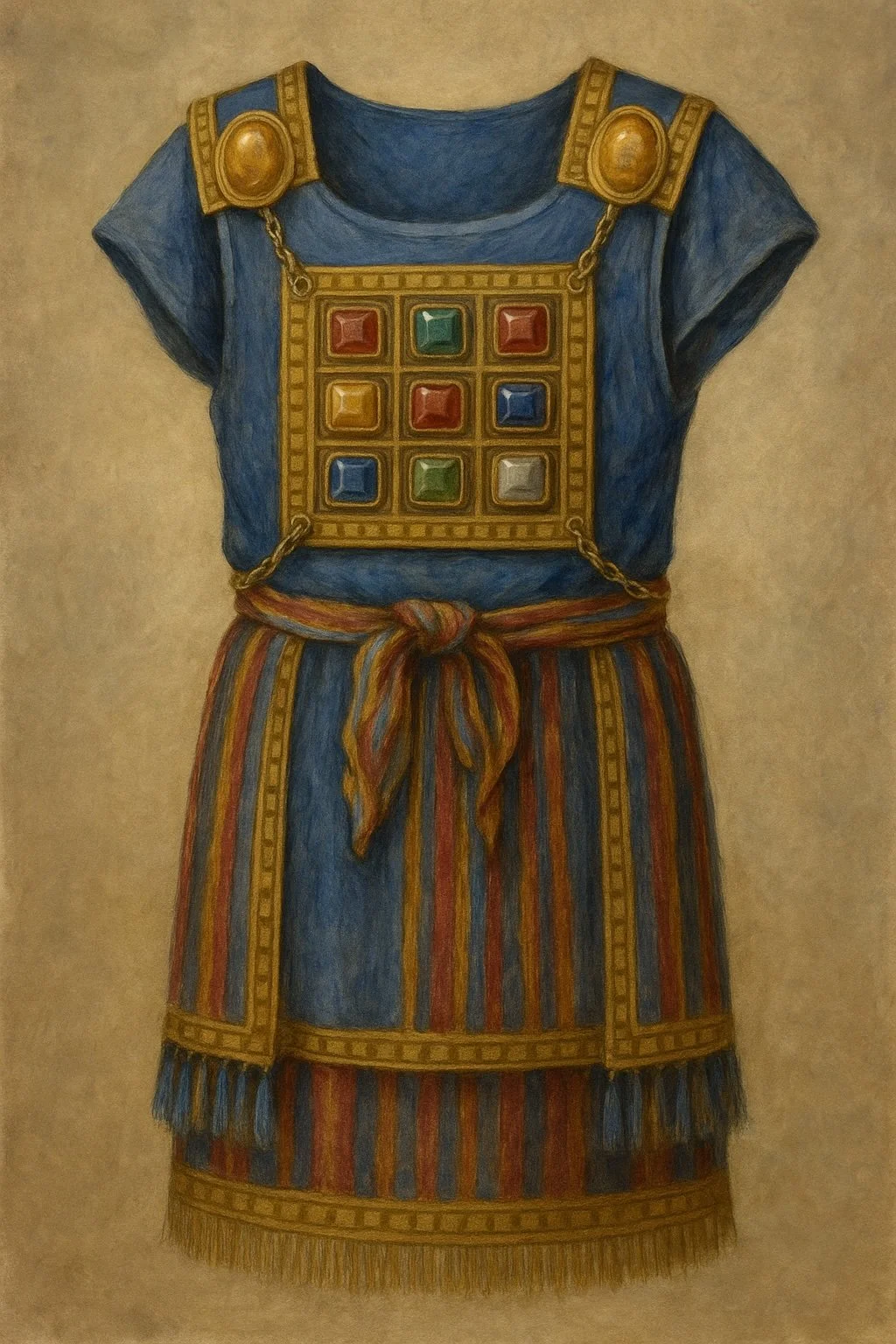
Precious jewels representing the people of God were embedded in the priests’ clothing.
Precious Stones in the High Priest’s Breastplate
One of the most familiar lists of stones comes from Exodus 28. The high priest wore a breastplate that held twelve stones in four rows. Each stone represented one of the twelve tribes of Israel. The names of the tribes were engraved on the stones, reminding Israel that their identity rested in God’s faithfulness.
The stones listed in Exodus 28:17-20 include sardius, topaz, emerald, turquoise, sapphire, diamond, jacinth, agate, amethyst, beryl, onyx, and jasper. These stones formed a kind of portable memorial. When the high priest entered the sanctuary, he carried the names of the tribes over his heart. The stones reflected the light of the lampstand and the presence of God.
The specific identification of some stones is debated. Ancient names do not always match modern geological terms. Yet the meaning remains clear. The breastplate brought together the beauty of creation and the dignity of Israel’s calling.
Precious Stones in Creation and Judgment
Ezekiel 28 includes another list of stones. The prophet speaks of Eden as a place where beauty covered everything. Among the images are stones such as sardius, topaz, diamond, beryl, onyx, jasper, sapphire, turquoise, and emerald. The passage is poetic, drawing a connection between beauty and the order God set in creation.
The prophets also use stones as images of judgment. Lamentations speaks of the precious sons of Zion, once valued like fine gold, now regarded as clay pots. The comparison shows how far the people had fallen from their calling. The loss of beauty signals the loss of faithfulness.
Precious Stones in the New Jerusalem
The final list of stones in the Bible appears in Revelation 21. John describes the New Jerusalem with the language of brilliance. The walls are made of jasper. The city is like pure gold. The foundations of the walls are adorned with twelve stones. These include jasper, sapphire, chalcedony, emerald, sardonyx, sardius, chrysolite, beryl, topaz, chrysoprase, jacinth, and amethyst.
This list echoes the stones of the high priest’s breastplate. The repetition suggests continuity. What began with the tribes of Israel now becomes the foundation of the renewed creation. Beauty becomes a sign of God’s promise. The city itself becomes a place where light shines through every surface.
What Are the Twelve Precious Stones in the Bible?
The number twelve carries deep meaning in Scripture. It stands for wholeness, completeness, and the gathered people of God. The stones in Exodus and Revelation differ in order and type, but they share a common purpose. They represent the fullness of God’s work.
The twelve stones connected with Israel’s tribes include:
Sardius
Topaz
Emerald
Turquoise
Sapphire
Diamond
Jacinth
Agate
Amethyst
Beryl
Onyx
Jasper
Revelation’s list includes some similar names and some different ones. Ancient trade routes, translation differences, and geological uncertainty all shape how these names appear. Yet the symbolism remains stable. The stones stand for the people God gathers.
What Are the Seven Precious Stones in the Bible?
Some readers ask about the seven stones that appear together in different passages. While the Bible does not provide one fixed list of seven, certain stones appear repeatedly. These include jasper, sapphire, emerald, topaz, beryl, onyx, and amethyst.
The number seven often signals completeness. When the prophets or poets speak of stones in sevens, they may be drawing attention to beauty that reflects God’s character.
The Meaning and Symbolism of Precious Stones
Glory
Many stones appear in contexts where God’s presence is close. The prophets describe God’s throne in colors like sapphire and emerald. The brightness of the stones helps the reader imagine the radiance of God.
Covenant
The stones in the high priest’s breastplate remind the people that God knows them by name. Each stone is a marker of belonging.
Purity
Revelation’s stones point toward a future where creation is renewed. The stones shine in ways that reflect holiness.
Memory
Some stones connect with stories of faith. They point backward as well as forward. They help the reader remember how God has worked across generations.
Academic Perspective
Scholars note that ancient Near Eastern cultures shared many of the same stones found in the Bible. Excavations and inscriptions show that stones carried political, religious, and economic meaning. They appeared in royal jewelry, temple settings, and trade records. The biblical writers use these same stones to tell theological stories, linking Israel’s faith with the world they inhabited. As Old Testament scholar Nahum Sarna observed, the lists of stones in Exodus and Ezekiel reveal both the beauty of creation and the dignity of Israel’s worship.
Conclusion
Precious stones in the Bible offer more than decoration. They provide a language for describing God’s presence, God’s people, and God’s hope for the world. They shine in stories of worship, judgment, and renewal. In their brightness, the reader catches a glimpse of the beauty God intends for creation.
