What Were the Dimensions of Solomon's Temple? Size, Height, and Meaning
Bible Reference / Bible Facts / Measurements and Objects
In Short
Solomon's Temple measured sixty cubits long, twenty cubits wide, and thirty cubits high (1 Kings 6:2). Using the common cubit of about eighteen inches, that is roughly 90 feet long, 30 feet wide, and 45 feet tall, about the height of a four-story building. Inside were three spaces: a porch, the Holy Place (forty cubits long), and the Most Holy Place, a perfect cube of twenty cubits on every side. Three stories of side rooms wrapped around the outside, and courtyards surrounded the whole. Built on Mount Moriah in the tenth century BCE, the Temple replaced the Tabernacle as the place where God chose to put his name among his people.
"The house that King Solomon built for the LORD was sixty cubits long, twenty cubits wide, and thirty cubits high." (1 Kings 6:2, NRSV)
Want to convert other biblical units? Try the Bible Measurement Converter.
Solomon's Temple Dimensions at a Glance
The numbers below come from 1 Kings 6 to 7 and 2 Chronicles 3 to 4. Feet are approximate, using an 18-inch cubit. If Solomon's builders used the longer royal cubit (about 20.6 inches), add roughly 15 percent. For more on how the cubit was measured, see What Is a Cubit in the Bible?
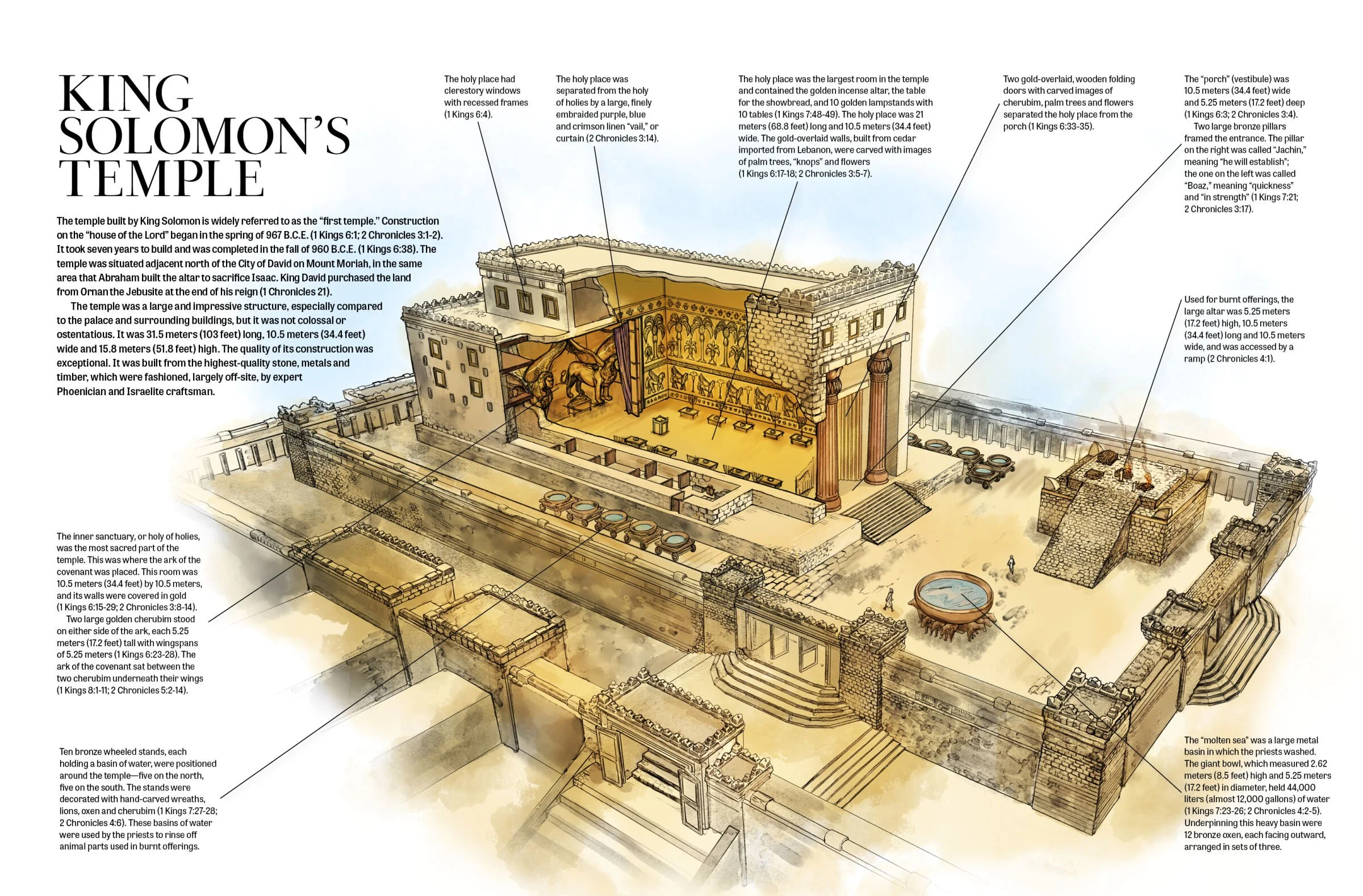
See the Temple Complex in it’s varied levels, furniture, and entry points. Source.
| Part of the Temple | Cubits | Approximate Feet | Scripture |
|---|---|---|---|
| Main building | 60 long, 20 wide, 30 high | 90 x 30 x 45 | 1 Kings 6:2 |
| Porch (vestibule) | 20 wide, 10 deep | 30 x 15 | 1 Kings 6:3 |
| Holy Place (nave) | 40 long, 20 wide, 30 high | 60 x 30 x 45 | 1 Kings 6:17 |
| Most Holy Place | 20 x 20 x 20 | 30 x 30 x 30 | 1 Kings 6:20 |
| Cherubim (each) | 10 high, wings 10 across | 15 high | 1 Kings 6:23–27 |
| Side rooms | 5, 6, and 7 wide by story; each story 5 high | 7.5 to 10.5 wide | 1 Kings 6:6, 10 |
| Bronze pillars, Jachin and Boaz | 18 high, plus 5-cubit capitals | 27 + 7.5 | 1 Kings 7:15–16 |
| Bronze sea | 10 across, 5 high, 30 around | 15 x 7.5 | 1 Kings 7:23 |
| Bronze altar | 20 x 20, 10 high | 30 x 30 x 15 | 2 Chronicles 4:1 |
Where Was Solomon's Temple Built? Mount Moriah and Abraham
Scripture gives the Temple an address with a long memory. "Then Solomon began to build the house of the LORD in Jerusalem on Mount Moriah, where the LORD had appeared to his father David, at the place that David had designated, on the threshing floor of Ornan the Jebusite" (2 Chronicles 3:1, NRSV).
Moriah is the only other place that name appears in the Bible: it is where God sent Abraham with Isaac. "Take your son, your only son Isaac, whom you love, and go to the land of Moriah, and offer him there as a burnt offering on one of the mountains that I shall show you" (Genesis 22:2). On that mountain God provided a ram in Isaac's place, and "Abraham called that place 'The LORD will provide'" (Genesis 22:14). That name is Yahweh Jireh, the LORD Will Provide.
So the bronze altar of Solomon's Temple, where sacrifices were offered day after day, stood on the same ridge where God first provided a sacrifice. The Temple did not begin with Solomon's building plans. It began with a father's faith a thousand years earlier. For the timeline, see When Did Abraham Live? and When Did Solomon Live?
When was it built? Construction began "in the four hundred eightieth year after the Israelites came out of the land of Egypt, in the fourth year of Solomon's reign" (1 Kings 6:1), usually dated around 966 BCE. It took seven years to finish (1 Kings 6:38).
How Tall Was the Temple?
Solomon's Temple was thirty cubits tall, about 45 feet with an 18-inch cubit, or a little over 51 feet with the royal cubit. Second Chronicles notes that Solomon built using "cubits of the old standard" (2 Chronicles 3:3), which many scholars take to mean the longer royal cubit. Either way, the Temple stood roughly as tall as a four-story building.
That was not towering by the standards of the ancient world. Egyptian and Mesopotamian temples were far larger. Israel's sanctuary was defined not by scale but by covenant. Its height expressed dignity, not domination. It invited awe but left room for approach. It was a building meant for people to enter, not observe from a distance.
What about the 120-cubit porch? Second Chronicles 3:4 says the porch in front of the nave rose "one hundred twenty cubits," which would be about 180 feet, a tower four times taller than the building behind it. First Kings gives no height for the porch at all. Some ancient Greek and Syriac manuscripts read twenty cubits instead, and many scholars think that is the original figure. Most reconstructions follow the smaller figure.
Did the height change inside? Yes. The Holy Place rose the full thirty cubits, but the Most Holy Place was only twenty cubits high (1 Kings 6:20). Most scholars think its floor was raised, or that an upper space sat above it. Either way, the vertical lines narrowed as one moved inward, creating a sense of increasing focus. The outer height gave the building presence. The inner proportions gave it mystery.
How did it compare to later temples? Herod's Temple rose far higher, to about one hundred cubits according to Josephus. But Solomon's Temple was shaped by a different imagination. Its purpose was to hold God's presence in the midst of the people. See Herod's Temple: Dimensions and History.
Architectural height teaches the body how to feel. It lifts the eyes and slows the pace. In the Temple, the thirty cubits formed a space where worshipers learned humility and expectation. It stood in sunlight. It cast shadows. People walked its courts and listened to prayers echo inside its walls.
Walking Through Solomon's Temple, Room by Room
The layout echoed the Tabernacle, moving from open courtyard to the most sacred space at the center. Here is what a priest would pass through on the way in.
1. The Courtyards
The Temple stood within "the inner court with three courses of dressed stone to one course of cedar beams" (1 Kings 6:36). A larger outer court held the people at festivals. Worship involved all Israel together in prayer, offering, and celebration. Here stood the bronze altar for burnt offerings and the great bronze sea, a basin "ten cubits from brim to brim" resting on twelve bronze oxen (1 Kings 7:23–25), where priests washed. For the earlier pattern, see The Altar of Burnt Offering and How Big Was the Tabernacle Courtyard?
2. The Porch and the Pillars
The porch ran the full twenty-cubit width of the building and was ten cubits deep (1 Kings 6:3). Before it stood two bronze pillars, eighteen cubits high, cast by Hiram of Tyre. "He set up the pillar on the south and called it Jachin; and he set up the pillar on the north and called it Boaz" (1 Kings 7:21). Jachin likely means "he establishes" and Boaz "in him is strength." The pillars held up nothing; they functioned as signs at the threshold, a sermon in bronze before anyone stepped inside.
3. The Holy Place
The main hall measured forty cubits long and twenty wide (1 Kings 6:17). Stone walls were lined with cedar, "so that no stone was seen" (1 Kings 6:18), and the whole was overlaid with gold. Carvings of cherubim, palm trees, and open flowers covered the walls (1 Kings 6:29), recalling the garden of Eden. Here stood ten golden lampstands, the table for the bread of the Presence, and the golden altar of incense (1 Kings 7:48–49). This was the room of daily priestly ministry: neither vast nor cramped, with enough room for service and enough shape to sustain reverence.
4. The Most Holy Place
At the back lay the inner sanctuary: "twenty cubits long, twenty cubits wide, and twenty cubits high; he overlaid it with pure gold" (1 Kings 6:20). A perfect cube. Two cherubim of olive wood, each ten cubits tall, spread their wings wall to wall over the Ark of the Covenant (1 Kings 6:23–28). No window, no lampstand. Only the high priest entered, once a year. The cube shape echoed the Tabernacle and returns at the end of the Bible, where the New Jerusalem's "length and width and height are equal" (Revelation 21:16). The whole city becomes the Most Holy Place. See Revelation 21:9–21 Commentary and What Objects Were in the Ark of the Covenant?
5. The Side Rooms
Three stories of rooms wrapped around the outside walls. "The lowest story was five cubits wide, the middle one was six cubits wide, and the third was seven cubits wide" (1 Kings 6:6). Each story grew wider because the Temple wall stepped inward as it rose, giving the beams a ledge to rest on without cutting into the sanctuary. These rooms stored offerings, vestments, and sacred vessels. Worship required preparation, care, and organization.
A Quiet Construction Site
One detail is easy to miss. "The house was built with stone finished at the quarry, so that neither hammer nor ax nor any tool of iron was heard in the temple while it was being built" (1 Kings 6:7). Even the building process honored the holiness of the place.
What Do the Temple's Dimensions Mean?
The measurements are not trivia. Scripture records them with the same steady precision found in the instructions for the Tabernacle, as if the text knows that space shapes faith.
Ordered worship. The proportions reflect a God who creates with care. The Temple doubled the Tabernacle's length and width while keeping its pattern, so the permanent house carried forward the shape of the wilderness tent.
Increasing holiness. The movement from courtyard to porch to Holy Place to cube is a movement inward and upward, from gathering to offering to encounter.
Permanence. Unlike the Tabernacle, the Temple stood fixed in Jerusalem. It anchored Israel's identity for nearly four centuries, until the Babylonians burned it in 587 BCE (2 Kings 25:9).
God's nearness. When the Ark was brought in, "a cloud filled the house of the LORD, so that the priests could not stand to minister because of the cloud; for the glory of the LORD filled the house of the LORD" (1 Kings 8:10–11). The name for this is Yahweh Shammah, the LORD Is There, and the Temple was its address. See also God Who Dwells with His People.
Yet Solomon himself knew the building could not contain God. At the dedication he prayed, "But will God indeed dwell on the earth? Even heaven and the highest heaven cannot contain you, much less this house that I have built!" (1 Kings 8:27). Read the full prayer in The Prayer of Solomon at the Temple Dedication.
Solomon's Temple in the New Testament and Acts
The Temple's story does not end with its measurements. Jesus said, "I tell you, something greater than the temple is here" (Matthew 12:6), and spoke of his own body as the temple (John 2:19–21). See Destroy This Temple, and in Three Days I Will Raise It Up (John 2:19). In him, God's presence that once filled the Most Holy Place came to live among us as Immanuel, God with Us.
The book of Acts carries the thread forward in three ways:
Solomon's name lived on. The early church gathered in a colonnade of Herod's Temple called Solomon's Portico. After the healing at the Beautiful Gate, "all the people ran together to them in the portico called Solomon's Portico, utterly astonished" (Acts 3:11). See Healing at the Beautiful Gate (Acts 3:1–10) and Peter Speaks to the Onlookers (Acts 3:11–26).
Believers worshiped there daily. "Day by day, as they spent much time together in the temple" (Acts 2:46). See The Fellowship of Believers (Acts 2:42–47).
Stephen quoted Solomon's own point. "But it was Solomon who built a house for him. Yet the Most High does not dwell in houses made with human hands" (Acts 7:47–48). See Tent, Temple, and God's Freedom (Acts 7:44–50)and Stephen's Speech in Acts 7 Explained.
Peter later told believers, "like living stones, let yourselves be built into a spiritual house" (1 Peter 2:5). The cedar and gold are gone, but the purpose of the Temple remains: a people where God makes his home.
FAQ
How big was Solomon's Temple in feet? About 90 feet long, 30 feet wide, and 45 feet high, using an 18-inch cubit. With the royal cubit, about 103 by 34 by 51 feet.
How tall was Solomon's Temple? Thirty cubits, about 45 feet, or roughly four stories (1 Kings 6:2). Second Chronicles 3:4 gives the porch a height of 120 cubits, but many scholars think the original figure was twenty.
Why was the Most Holy Place a cube? The cube symbolized completeness and perfection. It set the Most Holy Place apart as the center of God's presence, and Revelation 21:16 pictures the New Jerusalem as a cube.
How did Solomon's Temple differ from the Tabernacle? The Temple was twice as long and wide, three times as tall, permanent, and built with stone, cedar, and gold. The Tabernacle was a portable tent. See What Is the Tabernacle in the Bible?
What were the side rooms for? They stored offerings, vestments, and sacred vessels used in the priests' work.
Where was Solomon's Temple built? On Mount Moriah in Jerusalem (2 Chronicles 3:1), the same region where Abraham offered Isaac (Genesis 22:2).
When was Solomon's Temple destroyed? The Babylonians burned it in 587 BCE (2 Kings 25:8–9). The Second Temple was built after the exile. See When Did the Second Temple Get Destroyed?
Related Content
Works Consulted
Alfred Edersheim, The Temple: Its Ministry and Services
Zondervan Illustrated Bible Backgrounds Commentary: Old Testament, vol. 3 (1 and 2 Kings)
Leen Ritmeyer, The Quest: Revealing the Temple Mount in Jerusalem
Mordechai Cogan, 1 Kings, Anchor Yale Bible
Armstrong Institute of Biblical Archaeology, "Infographic: King Solomon's Temple"
