What Was the Bronze (Molten) Sea?
Quick Summary
The Bronze Sea—sometimes called the Molten Sea—was a massive basin in Solomon’s Temple used by the priests for ritual washing. Measuring ten cubits from rim to rim and five cubits high, and holding more than 10,000 gallons of water, it stood as a sign of cleansing, preparation, and God’s overflowing provision. Its size and imagery shaped Israel’s worship and offered a picture of renewal at the threshold of God’s presence.
Introduction
When Israel imagined the courtyard of Solomon’s Temple, few objects captured attention like the Bronze Sea. It was enormous. Its surface reflected the sky, the temple walls, and the steady movement of the priests who served nearby. The biblical writers describe it in careful detail, inviting readers to see not just a utilitarian basin but a statement about God’s holiness and the priesthood’s daily work.
The Bronze Sea replaced the smaller basin in the tabernacle, expanding the idea of ritual cleansing into something both practical and symbolic. Its scale signaled that preparation mattered. Approaching God was not casual. It involved intention, washing, and readiness. And yet the Sea also communicated something generous. It held more water than the priests needed—overflowing abundance as a visual reminder of God’s capacity to cleanse and restore.
This guide explores the dimensions, construction, and meaning of the Bronze Sea and places it within the wider story of Israel’s worship.
Dimensions of the Bronze Sea
1 Kings 7:23–26 gives the essential measurements:
Ten cubits across from rim to rim (about 15 feet or 4.5 meters)
Five cubits high (about 7.5 feet or 2.3 meters)
Thirty cubits in circumference
Thickness of a handbreadth
Capacity of 2,000 to 3,000 baths (likely between 11,500 and 17,000 gallons)
The sheer size made this basin one of the most striking objects in the outer court. Its circular shape differed from many other temple furnishings and may have visually suggested completeness or wholeness.
The Sea rested on twelve bronze oxen—three facing outward in each cardinal direction. The oxen symbolized strength and service, grounding the basin in images of stability and offering.
Materials and Construction
The Bronze Sea was cast from large quantities of bronze, a metal associated with durability and the boundary between the holy and the common. While Solomon’s Temple included gold-covered objects inside the sanctuary, bronze dominated the outer court. It marked the beginning of sacred space.
Bronze craftsmanship in this period was highly skilled. The basin’s smooth interior, rounded rim, and ornate oxen base point to the advanced artistry of the era. According to Scripture, a master craftsman named Hiram of Tyre oversaw much of the bronze work (1 Kings 7:13–14).
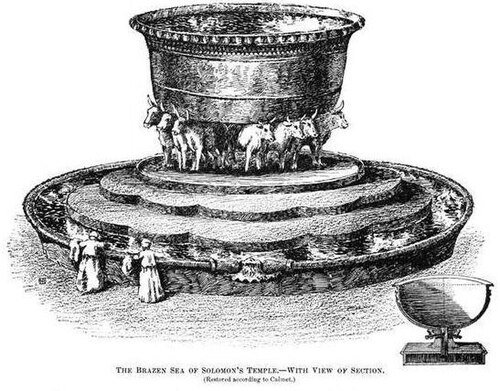
An artist’s rendition of the molten sea. Source
Purpose in Temple Worship
The primary purpose of the Bronze Sea was ritual cleansing for the priests. Before offering sacrifices or entering the sanctuary, the priests washed their hands and feet (Exodus 30:17–21). In the tabernacle, a smaller basin fulfilled this role. In Solomon’s Temple, the Sea expanded it.
The water was not used for bathing but for ceremonial purification. It reminded the priests that approaching God required humility and readiness. Ritual cleansing was not about physical dirt. It was about orientation of the heart.
The Sea’s excessive capacity also supplied water for other courtyard needs, such as rinsing offerings or filling smaller basins.
Symbolic Meaning
The Bronze Sea carried several layers of meaning that shaped Israel’s imagination.
Cleansing
Its primary message was purification. It stood between ordinary life and sacred service, signaling that turning toward God involves washing away what hinders.
Abundance
The enormous volume of water suggested divine generosity. God does not offer just enough to cleanse but more than enough.
Stability and Strength
The twelve oxen beneath the Sea served as a foundation. Their posture facing outward may symbolize God’s blessing extended in every direction.
Creation Imagery
Some scholars note that the word "sea" often represents the waters of creation or chaos. Positioned in the temple—the cosmic meeting place—it may have hinted at God’s power over the forces of disorder.
Role in Israel’s Worship Life
Standing in the courtyard, the Bronze Sea shaped the daily work of the priests. Every sacrifice involved movement to and from the basin. It was not a ritual reserved for special occasions but woven into the ordinary rhythm of worship.
The Sea also connected past and future. It echoed the smaller basin of the tabernacle and anticipated later prophetic visions of cleansing waters flowing from God’s presence.
Though the Sea does not appear in the Second Temple period, its imagery survives in biblical memory—especially in the idea of God providing cleansing and renewal for the people.
