Who Are the Twelve Tribes of Israel?
Quick Summary
The twelve tribes of Israel descend from the twelve sons of Jacob, whose name was changed to Israel. Each tribe carried unique roles, territories, and prophetic destinies. These tribes shaped the history, identity, and spiritual framework of ancient Israel, and their legacy continues into the New Testament and beyond.
Introduction
The story of the twelve tribes of Israel begins with a single man—Jacob. Renamed Israel after wrestling with God (Genesis 32:28), Jacob became the father of twelve sons. These sons and their descendants formed the foundational family units for the Israelite nation. Though centuries have passed since they first camped together in the wilderness or settled across the Promised Land, the twelve tribes remain a central concept in both Jewish and Christian thought. Their names appear on the gates of the New Jerusalem in Revelation 21:12 and shape the very structure of Old Testament history.
The Sons of Jacob: Founders of the Tribes
Jacob had twelve sons by four women—Leah, Rachel, Bilhah, and Zilpah. Each son became the progenitor of a tribe. The twelve sons are:
Reuben – Jacob's firstborn by Leah. Reuben lost his birthright due to his sin with Bilhah (Genesis 35:22).
Simeon – Also born to Leah. Along with Levi, Simeon was involved in the massacre at Shechem (Genesis 34).
Levi – Known for the priestly line of Aaron, the Levites were set apart for tabernacle service.
Judah – Ancestor of King David and Jesus (Matthew 1:2–3). Judah became the leading tribe of the southern kingdom.
Dan – Known for idolatry (Judges 18), yet still counted among the tribes.
Naphtali – A tribe in northern Israel, descended from Bilhah, Rachel's maidservant.
Gad – A tribe known for its warriors, descended from Zilpah, Leah’s maidservant.
Asher – Also descended from Zilpah, blessed with abundance and olive oil (Genesis 49:20).
Issachar – Known for wisdom and labor, descended from Leah.
Zebulun – Tribe situated near the sea, also a son of Leah.
Joseph – Instead of receiving a tribe under his name, Joseph’s two sons—Ephraim and Manasseh—were each given tribal status.
Benjamin – The youngest, born to Rachel. Saul, Israel’s first king, came from this tribe.
Why Are Ephraim and Manasseh Tribes?
Jacob adopted Joseph’s two sons as his own (Genesis 48:5), effectively giving Joseph a double portion of inheritance. This means that while Levi did not receive a land allotment like the others, the total number of land-holding tribes still came to twelve. This also fulfilled Joseph’s reward for saving his family during famine (Genesis 45).
The Levites: A Tribe Without Territory
Though Levi was one of the twelve sons, the tribe of Levi was set apart for priestly duties (Numbers 1:47–53). They did not receive a large land inheritance like the others, but were given cities scattered throughout Israel (Joshua 21). Their role was spiritual rather than territorial.
Twelve Tribes of Israel Map
Under Joshua’s leadership, the twelve tribes were allotted specific territories (Joshua 13–19). Each tribe’s inheritance reflected prophetic blessings, practical geography, and military accomplishment. Judah received the southern region. Ephraim and Manasseh took central Israel. The northern tribes like Naphtali and Asher settled near the Sea of Galilee. Reuben, Gad, and half of Manasseh chose land east of the Jordan (Numbers 32).
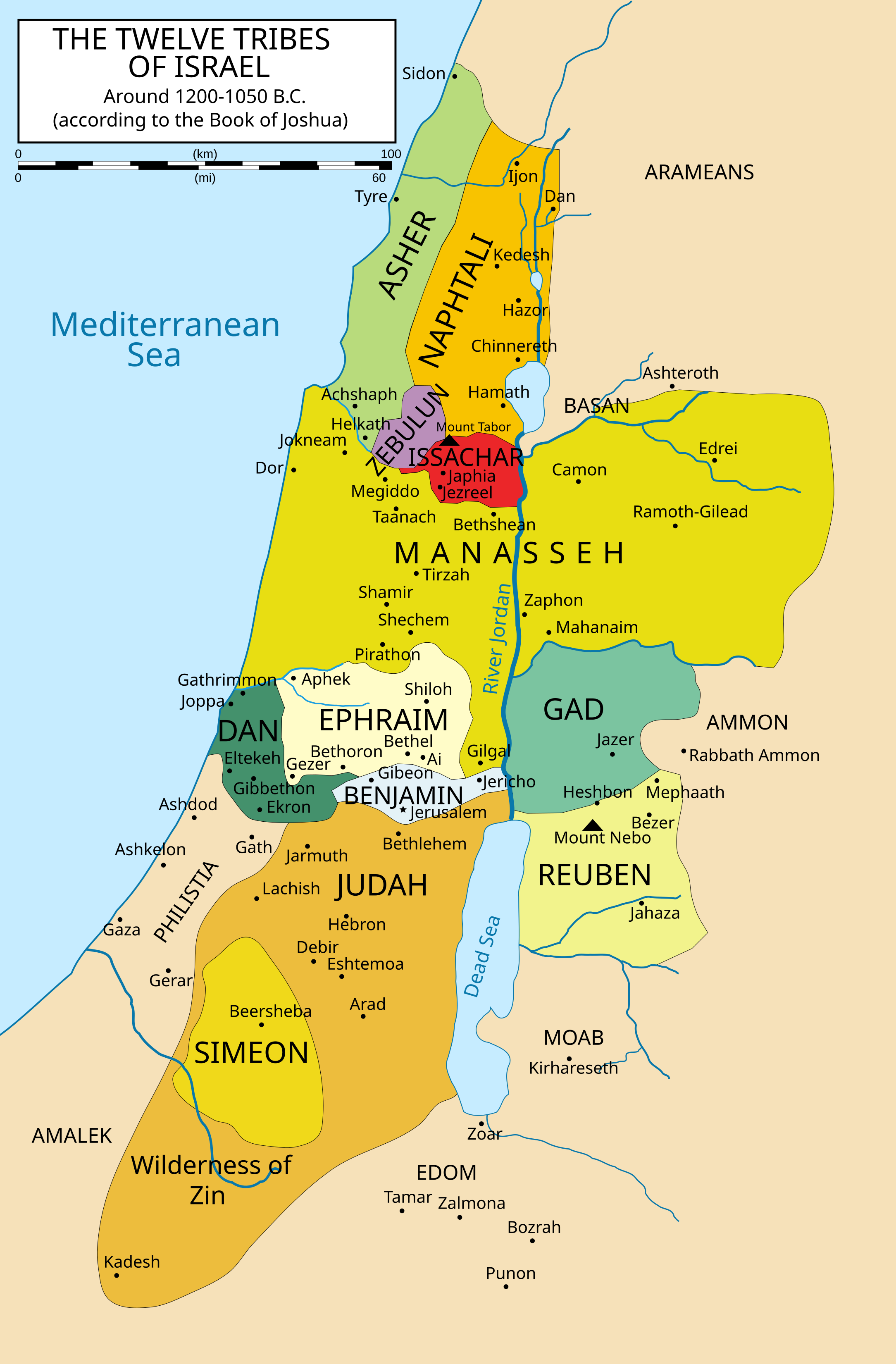
This map by Wikimedia Commons helpfully shows the territory and boundaries of the Twelve Tribes of Israel.
Prophetic Blessings and Tribal Identity
In Genesis 49, Jacob blesses each of his sons with words that often echo their tribe’s future roles. For example:
Judah is promised rulership: "The scepter shall not depart from Judah" (Genesis 49:10).
Levi and Simeon are rebuked for violence but scattered, fulfilling the Levites’ later priestly role.
Joseph is blessed with fruitfulness and strength.
Moses later pronounces blessings on the tribes in Deuteronomy 33. These poetic affirmations highlight both material blessings and spiritual identity.
Tribes in the Wilderness and Temple Service
During the wilderness journey, the tribes were arranged in camps around the Tabernacle (Numbers 2). Each tribe had its banner, leader, and specific placement—demonstrating both order and spiritual proximity to God’s presence.
The Levites themselves were subdivided into clans:
Kohathites – cared for the holy items.
Gershonites – cared for the curtains and coverings.
Merarites – cared for the structural elements of the Tabernacle.
The Tribes After the Kingdom Split
After Solomon’s reign, the kingdom split into two:
Northern Kingdom (Israel) – 10 tribes, often symbolized by Ephraim.
Southern Kingdom (Judah) – included Judah and Benjamin (and many Levites who remained faithful to temple service).
The northern tribes were eventually conquered by Assyria and scattered (2 Kings 17). These are often referred to as the "lost tribes" of Israel.
Are the Tribes Still Around Today?
While the full tribal identities have been obscured over time due to exile, assimilation, and diaspora, elements of each tribe persist in Jewish tradition. The priestly line (Levites and Kohanim) is still recognized today. Some Jewish families maintain tribal names like "Levi" or "Cohen."
In the book of Revelation, the twelve tribes are mentioned again in symbolic form (Revelation 7:5–8), with some variations. Dan is omitted, and both Joseph and Manasseh are listed. This reminds us that God remembers his covenant, even when history forgets.
Lessons from the Twelve Tribes
Diversity of Gifts: Each tribe had different callings—warriors, priests, farmers, judges.
Spiritual Identity: Israel was more than geography—it was a covenant people.
God’s Faithfulness: Despite rebellion, God preserved a remnant from each tribe.
Unity and Division: The tribal system allowed both local identity and national cohesion—but also revealed the risk of fragmentation when worship faltered.
Explore More
For further study:
Tribes of Israel: A History by Steven Weitzman
The New Moody Atlas of the Bible by Barry J. Beitzel
Zondervan Illustrated Bible Dictionary
Meaning for Today
The twelve tribes remind us that God works through families, communities, and history. Though each tribe had its flaws, their names endure as testimony to God’s faithfulness. Christians, too, are called into a spiritual family—grafted into Israel’s story (Romans 11). The names of the twelve tribes engraved on the New Jerusalem’s gates (Revelation 21:12) are a permanent reminder that God redeems history and gathers his people from every tribe, tongue, and nation.

