The Altar of Burnt Offering: Size, Materials, and Purpose in the Tabernacle
Quick Summary
The Altar of Burnt Offering stood in the courtyard of the tabernacle, serving as the primary place for sacrifices in Israel’s worship. Built of acacia wood and overlaid with bronze, the altar measured five cubits by five cubits and stood three cubits high. It welcomed daily offerings, thanksgiving sacrifices, and moments of reconciliation, reminding Israel that worship begins with honesty and that God meets the people with grace.
Introduction
When an Israelite entered the courtyard of the tabernacle, the first object seen was the Altar of Burnt Offering. Before a priest approached the Holy Place, before incense rose or lamps were tended, life with God began at this large bronze altar. Its presence taught something profound: relationship with God grows through truth, gratitude, and God’s mercy.
Exodus 27:1–8 gives detailed instructions for constructing the altar, anchoring it firmly in Israel’s story. Unlike the golden lampstand or the Table of Showbread, this altar was not ornate. It was built for work, for fire, for the weight of daily worship. Its dimensions and materials reflect both the seriousness of sacrificial life and the welcome extended to every person who approached.
Exploring its size, materials, and purpose reveals how this altar shaped Israel’s understanding of worship and invited the people to draw near to the God who is faithful.
Dimensions of the Altar
Exodus 27:1 records the measurements clearly:
Five cubits long (approximately 7.5 feet or 2.3 meters)
Five cubits wide (a perfect square)
Three cubits high (approximately 4.5 feet or 1.4 meters)
The altar’s square shape conveyed stability and balance. It stood tall enough to command attention, yet low enough for priests to work atop it without difficulty.
Construction Details
The altar was constructed of durable acacia wood, a material resistant to insects and decay, then overlaid with bronze. Its bronze covering distinguished it from the gold-covered furnishings inside the Holy Place. Bronze symbolized endurance and the earthiness of sacrifice.
A bronze grate sat inside the altar, supporting the fire and allowing ashes to fall below. Rings and poles enabled the altar to be carried as Israel traveled.
Four horns rose from each corner, molded as part of the altar itself—small but significant features that later became associated with protection (1 Kings 1:50).
What the Altar Looked Like
Many readers imagine a massive stone structure, but Scripture describes a hollow, portable altar—strong, functional, and designed for movement during Israel’s wilderness journey. The bronze grate, utensils, and poles formed a complete system for tending fire, handling offerings, and traveling.
The altar would have been one of the most visually striking objects in the courtyard: large, square, furnace-like, and continually active. Smoke rose from it morning and evening, marking the rhythm of worship.
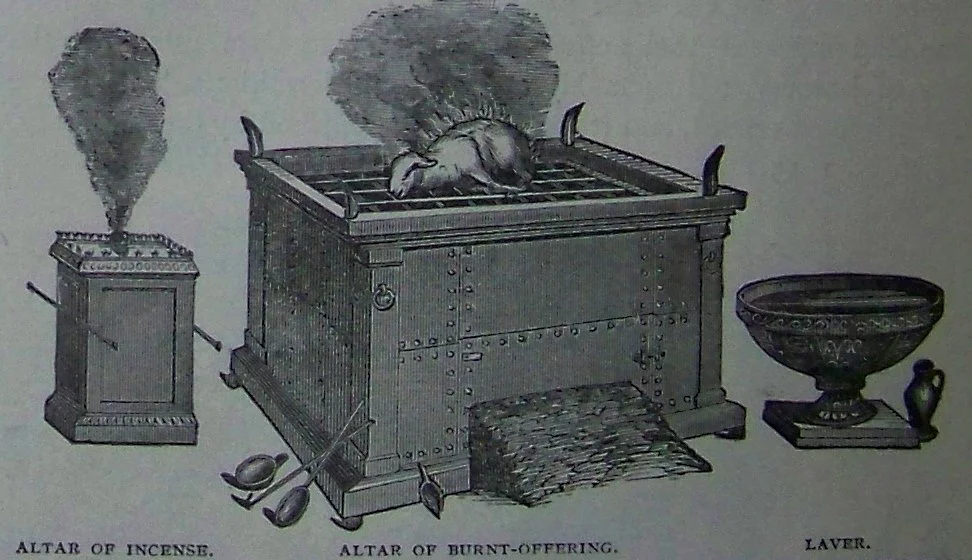
The Altar of Incense (left most), the Altar of Burnt Offering (center) and the Laver (for washing). This is an illustration from the 1890 Holman Bible. Source
Materials of the Altar
Acacia Wood
Acacia wood appears throughout the tabernacle’s construction. It is light, resilient, and common in the Sinai region. Using such wood emphasized that God works through ordinary material.
Bronze Overlay
Bronze, an alloy of copper and tin, represented strength. While gold marked the inner spaces of holiness, bronze marked the courtyard where ordinary people approached. The contrast taught that God meets the people in both holiness and in the common places of life.
Bronze’s ability to withstand heat made it ideal for an altar continually exposed to fire.
Purpose of the Altar
The Altar of Burnt Offering served several essential roles in Israel’s worship:
1. Daily Offerings
Morning and evening offerings were presented here (Exodus 29:38–42). These sacrifices framed the day with trust and gratitude.
2. Offerings of Thanksgiving
When someone experienced deliverance, healing, or abundance, they brought an offering. These moments expressed joy more than duty.
3. Offerings of Reconciliation
Here, sins were confessed and forgiven. The altar was not about fear but relief—a place where burdens met mercy.
4. Covenant Renewal
During communal recommitments—such as those described in Deuteronomy or Joshua—the altar played a central role. It reminded the people of their calling and God’s faithfulness.
Symbolism of the Altar
The altar held meaning far beyond its function.
Fire
Fire symbolized God’s presence, purification, and acceptance. The continual flame signaled that God remained near.
Horns
The four horns symbolized strength and protection. Later narratives use them as places of sanctuary, where people sought mercy.
Bronze
Bronze communicated endurance. The strength of bronze mirrored the steadfastness of God’s covenant.
Square Shape
Its perfect square shape suggested stability, balance, and the order of God’s design.
Placement in the Tabernacle
The altar stood at the entrance of the courtyard, directly in the path of anyone approaching the Holy Place. Its placement taught that worship begins with truth, humility, and grace.
Just as the priests could not bypass the altar to reach the Holy Place, the people could not bypass honesty in their relationship with God. Worship moved from the altar toward deeper fellowship.
Meaning for Israel
The altar shaped the imagination and faith of the people:
It taught that God welcomes honesty.
It reminded them that forgiveness is possible.
It invited gratitude in daily life.
It held together the rhythms of worship and community.
In seasons of wandering and seasons of stability, the altar marked God’s readiness to receive the people.
