Where Is Ararat?
Quick Summary
Mount Ararat is traditionally identified as the resting place of Noah’s ark after the flood, according to Genesis 8:4. In the Bible, however, “Ararat” refers not to a single mountain but to a broader region known as Urartu, located in what is now eastern Turkey and parts of Armenia and Iran. Understanding where Ararat is requires attention to biblical language, ancient geography, and historical tradition.
Introduction
Few biblical locations capture the imagination like Ararat. For centuries, the name has been linked to Noah’s ark, inspiring pilgrimage, speculation, and countless expeditions. In popular imagination, Ararat is a snowcapped mountain rising dramatically above the plains, hiding the remains of the ark somewhere on its slopes.
The Bible’s description, however, is more restrained. Genesis does not identify a specific peak, nor does it offer directions precise enough to satisfy modern cartography. Instead, Scripture names a region, one that was well known in the ancient Near East. To ask where Ararat is, then, is to step into the world of ancient geography rather than modern mapping.
Where Is Ararat in the Bible?
The key biblical reference appears in Genesis 8:4: “The ark came to rest on the mountains of Ararat.” The plural matters. The text does not say “Mount Ararat,” but “the mountains of Ararat,” suggesting a highland region rather than a single summit.
The name Ararat appears elsewhere in the Old Testament as well. In 2 Kings 19:37 and Isaiah 37:38, Ararat is named as the land to which the sons of the Assyrian king Sennacherib fled after assassinating him. Jeremiah 51:27 also mentions Ararat alongside Minni and Ashkenaz as kingdoms summoned against Babylon. In each case, Ararat functions as a geopolitical region, not merely a mountain.
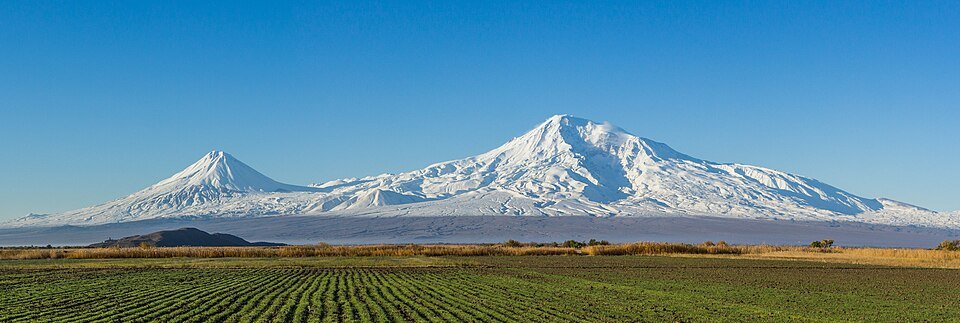
Mount Ararat rises high above the Armenian plain. Source
Ararat and the Kingdom of Urartu
Historically, the biblical Ararat corresponds to the kingdom of Urartu, which flourished between the ninth and sixth centuries BCE. Urartu occupied the highlands around Lake Van, encompassing parts of modern eastern Turkey, Armenia, and northwestern Iran.
Ancient Assyrian inscriptions frequently refer to Urartu as a powerful rival state. The Hebrew Bible’s use of “Ararat” reflects this same geopolitical reality, simply using the Hebrew form of the name. For the original audience of Genesis, Ararat would have evoked a recognizable region on the northern horizon of Mesopotamia.
This matters because it grounds the flood story in the known world of the ancient Near East. The ark comes to rest not in mythic nowhere, but in a real and formidable landscape associated with mountains, borders, and political power.
Mount Ararat in Modern Geography
Today, Mount Ararat usually refers to a specific volcanic mountain in eastern Turkey, near the borders of Armenia and Iran. Known in Turkish as Ağrı Dağı, it rises over 16,800 feet and dominates the surrounding terrain. Its prominence and isolation have made it a natural candidate for association with Noah’s ark.
By late antiquity and the medieval period, Jewish, Christian, and Islamic traditions increasingly identified this mountain as the resting place of the ark. Over time, the regional reference of Genesis narrowed in popular imagination to this singular peak.
While this identification is ancient and meaningful within tradition, it goes beyond what the biblical text itself explicitly states. Scripture leaves room for reverence without certainty.
Why the Bible Leaves the Location Vague
The Bible’s lack of precision is not accidental. Genesis is not written as a travel log or archaeological guide. Its interest lies in theological meaning rather than geographical detail.
By naming a region rather than a peak, the text emphasizes what happened rather than exactly where. The ark’s resting place signals the end of chaos and the beginning of renewal. The mountains of Ararat represent stability after upheaval, solid ground after judgment.
This restraint also prevents the story from being reduced to a single site. The power of the narrative lies in God’s faithfulness and covenant, not in a location that could be claimed, controlled, or exploited.
Ararat in Jewish, Christian, and Islamic Tradition
Later traditions filled in the gaps left by Scripture. Jewish writings such as Josephus connect the ark to Armenia, noting local traditions about remnants visible in his day. Early Christian writers followed similar lines, reinforcing the association.
In Islamic tradition, the Qur’an also recounts the flood, though it names Mount Judi as the resting place of the ark rather than Ararat. This variation highlights how flood traditions circulated widely in the ancient world, adapting to different cultural and geographical contexts.
Together, these traditions show how Ararat became a symbol of divine rescue and survival across religious boundaries.
Theological Meaning of Ararat
In the biblical story, Ararat is less about coordinates and more about transition. It marks the movement from judgment to mercy, from destruction to renewal. The ark does not land in a city or a garden, but on mountains, places often associated in Scripture with encounter between heaven and earth.
Ararat becomes a threshold. Humanity emerges again into a changed world, carrying both the memory of catastrophe and the promise of covenant. God’s bow in the clouds, not the mountain itself, becomes the lasting sign.
Seen this way, Ararat functions symbolically as well as geographically. It represents the moment when chaos gives way to order and when life is given another chance.
Does the Bible Say Where the Ark Is Today?
The Bible offers no information about the ark’s final fate beyond its resting in the mountains of Ararat. Scripture shows no interest in preserving the ark as a relic. Once its purpose is fulfilled, it disappears from the narrative.
This silence is instructive. Faith is not directed toward the ark or its location, but toward the God who saves and renews. The story points forward to covenant and responsibility, not backward to artifacts.
Why Ararat Still Matters
Ararat continues to matter because it anchors the flood story in the real world while resisting simplification. It invites readers to hold history, geography, and theology together without collapsing one into the other.
The question “Where is Ararat?” ultimately opens into a deeper question: what does it mean to find solid ground after the flood? The Bible answers not with a map, but with a covenant.
FAQ
Is Mount Ararat the same as the Ararat in Genesis?
Genesis refers to the mountains of Ararat as a region. The modern Mount Ararat is traditionally associated with this region but is not explicitly named in Scripture.
Where is Ararat located today?
Biblical Ararat corresponds to the ancient kingdom of Urartu, located in parts of modern eastern Turkey, Armenia, and northwestern Iran.
Did Noah’s ark land on a specific mountain?
The Bible does not identify a specific peak. It states that the ark came to rest in the mountains of Ararat.
Why is Ararat important in the Bible?
Ararat marks the transition from judgment to renewal after the flood and serves as a symbol of stability, mercy, and new beginnings.
Works Consulted
The New Revised Standard Version of the Bible.
John H. Walton, The Lost World of the Flood.
Nahum M. Sarna, Genesis.
James K. Hoffmeier, Ancient Israel in Sinai.
