Where is the Dead Sea?
Quick Summary
The Dead Sea is located in the Jordan Rift Valley between modern-day Israel and Jordan. It is the lowest land elevation on Earth, sitting over 1,400 feet below sea level. Known in ancient times as the Salt Sea, the Dead Sea appears throughout the Bible and lies near significant locations like Sodom, Gomorrah, and the wilderness of Judea. Its high salinity prevents aquatic life, giving it the name "Dead" Sea. Today, it remains a geographical, historical, and theological landmark.
Introduction
The Dead Sea has always held a mysterious and almost otherworldly place in the imagination of readers of Scripture. A sea that doesn't support life, a region where salt replaces fresh water, and a geography that holds the stories of judgment and refuge side by side. From Lot's escape in Genesis to the wilderness wanderings of David and John the Baptist’s ministry nearby, the Dead Sea region has quietly absorbed some of the Bible's most haunting and holy moments.
But what exactly is the Dead Sea? Where is it today? And why does it continue to matter—geographically, historically, and spiritually?
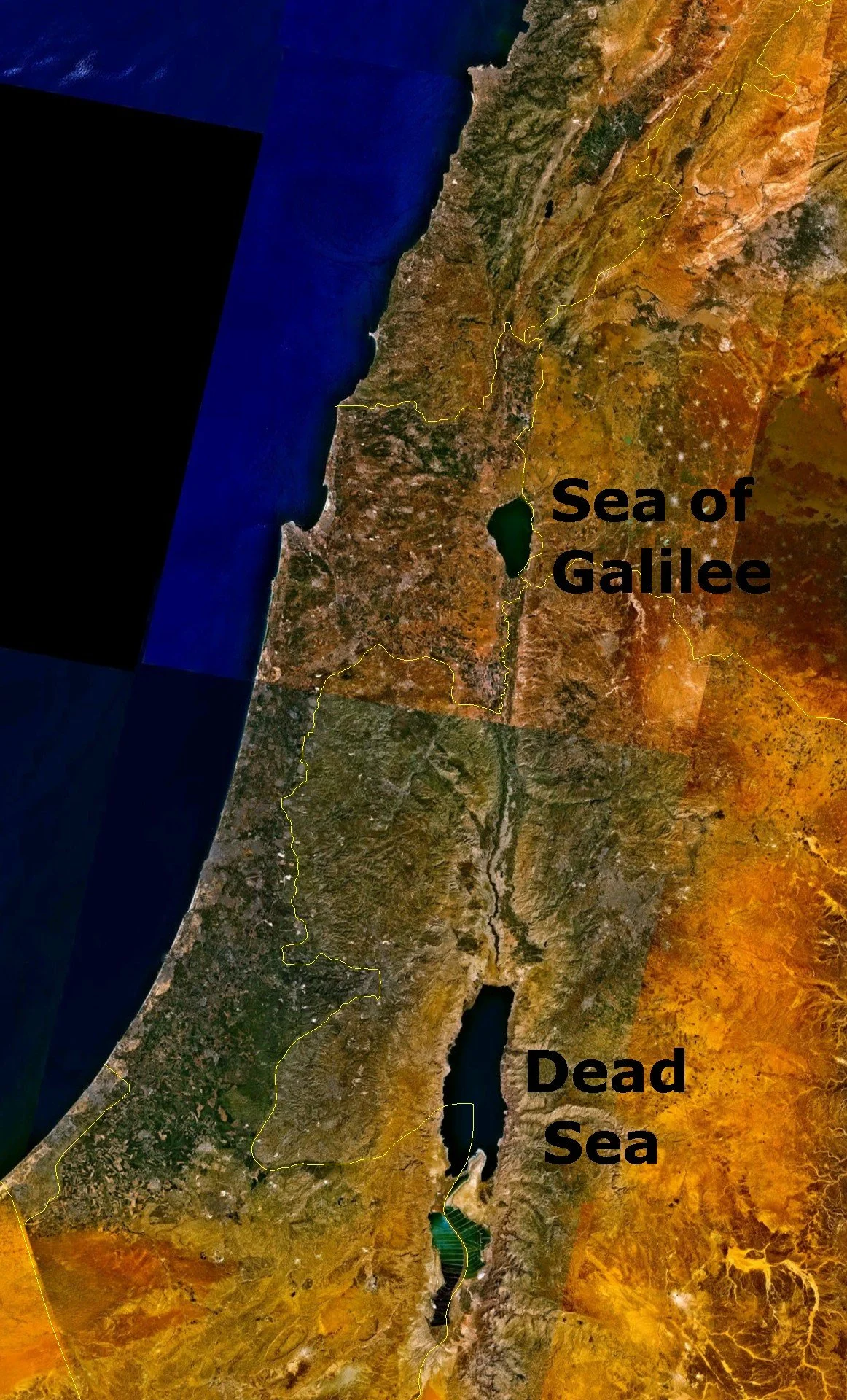
Satelite photo showing the connection of the Sea of Galilee in the north with the Dead Sea in the south connected via the Jordan River. Source
Where Is the Dead Sea Located?
The Dead Sea is situated in the Jordan Rift Valley, bordered by:
Israel to the west
Jordan to the east
It stretches roughly 50 miles (80 kilometers) from north to south and about 10 miles (16 kilometers) across at its widest point. The northern portion lies close to the ancient city of Jericho, while the southern end approaches the biblical territory of Edom.
The surface level of the Dead Sea is about 1,410 feet (430 meters) below sea level, making it the lowest land elevation on Earth.
Ancient Names and Biblical References
In the Bible, the Dead Sea is most often called the Salt Sea or the Sea of the Arabah:
Genesis 14:3 – "All these joined forces in the Valley of Siddim (that is, the Salt Sea)."
Deuteronomy 3:17 – Mentions "the Sea of the Arabah, the Salt Sea."
Joshua 15:2–5 – Describes the southern boundary of Judah as ending at the Salt Sea.
The term "Dead Sea" does not appear in Scripture, but it has been used historically by writers like Pliny the Elder and later church historians who noted its lifeless waters and harsh terrain.
Biblical Events Near the Dead Sea
1. Sodom and Gomorrah (Genesis 19)
The cities of Sodom and Gomorrah were located near the Dead Sea, possibly on its southeastern plain. The region became associated with divine judgment when the Lord rained fire and brimstone on the cities. Lot's wife, famously turned into a pillar of salt, is one of the best-known stories linked to the Dead Sea area.
Genesis 19:24–26: “Then the Lord rained on Sodom and Gomorrah sulfur and fire… But Lot’s wife, behind him, looked back, and she became a pillar of salt.”
2. Valley of Siddim – Battle of the Kings (Genesis 14)
The Valley of Siddim, near the Dead Sea, was the site of a massive alliance battle involving the kings of Sodom and Gomorrah. The area was filled with bitumen pits, and some of the kings fell into them as they fled. Abraham rescued Lot shortly afterward.
3. David’s Hideout – Ein Gedi (1 Samuel 24)
David fled from Saul and took refuge in the wilderness near the Dead Sea, particularly the area of Ein Gedi. The caves near this oasis still exist today and remain a popular hiking spot.
1 Samuel 24:1–4 recounts how David spared Saul’s life in one of these caves.
4. John the Baptist’s Ministry (Matthew 3:1–6)
John the Baptist preached and baptized near the Jordan River, not far from where it empties into the Dead Sea. The region was a symbolic place for repentance—a wilderness landscape that matched the spiritual barrenness being addressed.
5. Escape Route for Rebellion and Refuge
Several Old Testament figures used the Dead Sea region as a refuge during times of unrest:
David during Absalom’s revolt
Prophets traveling between Judah and Moab
Trade routes and military campaigns often moved along the Dead Sea’s edge
Modern Geography and Environmental Crisis
Today, the Dead Sea continues to shrink. Due to upstream water diversion from the Jordan River and mineral extraction industries, the sea level drops more than three feet (1 meter) per year. The southern basin has been divided into evaporation pools used for salt and mineral extraction.
Notable modern sites:
Ein Gedi Nature Reserve
Masada – Herod's fortress overlooking the sea
Qumran Caves – Where the Dead Sea Scrolls were found
Jordan River Baptismal Sites
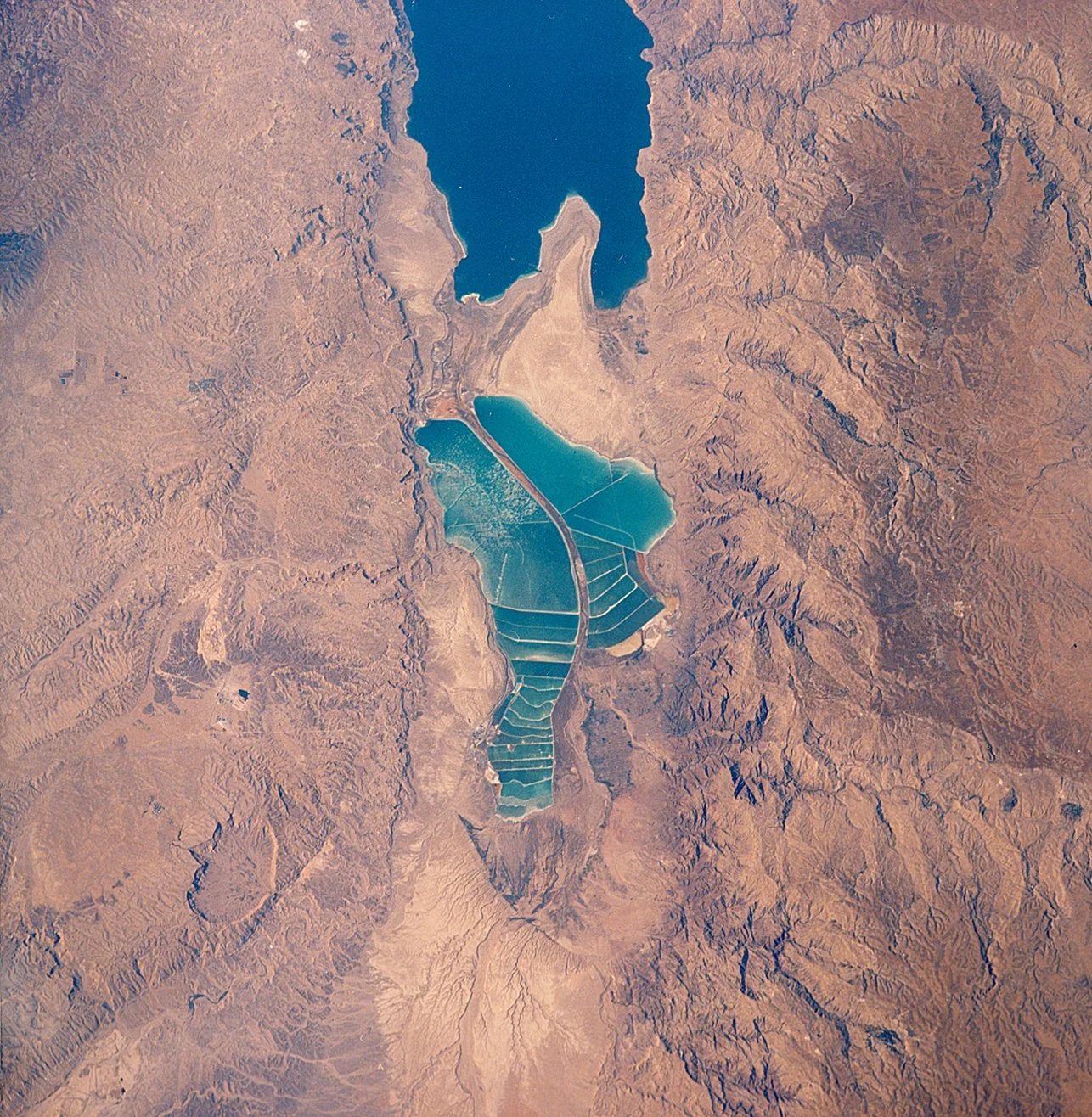
A satellite image shows the Dead Sea (uppermost) and the mineral extraction ponds to the south. Source
Scientific and Symbolic Meaning
1. Salinity and Density
The Dead Sea is nearly ten times saltier than the ocean. Its salinity—over 30%—prevents aquatic life, hence its name. However, it contains valuable minerals like magnesium, potassium, and bromine.
Floating in the Dead Sea is nearly effortless due to the high density. Many visitors come for therapeutic mud treatments and the novelty of the experience.
2. Symbolism in Scripture
The Dead Sea region represents extremes:
Death and Judgment – Sodom and Gomorrah, salt, and sulfur
Refuge and Solitude – David, John the Baptist
Wilderness and Repentance – A place where voices cry out and decisions are made
In Ezekiel’s vision of a future temple, he prophesies that waters will flow from the temple to the Dead Sea and make its waters fresh (Ezekiel 47:8–10). It’s a hopeful image of renewal and resurrection.
Books and Sources for Further Study
James K. Hoffmeier, The Archaeology of the Bible – Provides maps and historical insight into the Dead Sea region.
F.F. Bruce, The New Testament Documents: Are They Reliable? – Discusses geography and textual credibility, including Dead Sea references.
Joan E. Taylor, The Essenes, the Scrolls, and the Dead Sea – For those interested in Qumran and the surrounding desert culture.
Oxford Bible Atlas – For historical and modern maps.
The New Interpreter’s Dictionary of the Bible – Entries on Salt Sea, Qumran, Sodom, and wilderness themes.
Meaning for Today
The Dead Sea invites reflection on endings and beginnings, judgment and grace, barrenness and the hope of life restored. It’s a place where the land bears witness to human rebellion, divine mercy, and the ache for renewal.
Whether seen as a place of judgment (Sodom), refuge (David), or transformation (Ezekiel’s vision), the Dead Sea reminds us that the driest and saltiest places in life may still hold promise.
It’s not just a body of water—it’s a body of memory, loss, and surprising grace.

