How Big Was the Tabernacle Courtyard? Dimensions, Layout, and Meaning
Quick Summary
The Tabernacle courtyard measured 100 cubits long and 50 cubits wide, forming the outer sacred space where Israel approached God in the wilderness. This open-air enclosure framed the life of worship, holding the Bronze Altar, the laver, and the entrance to the holy tent. Its dimensions carried theological weight, expressing order, approach, purity, and the communal nature of Israel’s relationship with God.
Introduction
The Tabernacle stood at the heart of Israel’s wilderness journey. It was a living reminder that God traveled with the people. Before anyone reached the sanctuary or the innermost Holy of Holies, they stepped into the courtyard. The courtyard was large, visible, and accessible. It held the rhythm of sacrifice, cleansing, and prayer. It was a world shaped by linen curtains, bronze pillars, and the steady actions of priests and families bringing offerings.
The Bible gives the courtyard’s size in practical cubits, grounding sacred space in ordinary human measurement. Like the cubit, the courtyard belonged to the shared language of work and building. Yet these measurements carried meaning far beyond their practicality.
The Tabernacle stood at the heart of Israel’s wilderness journey. It was not simply a tent of worship but a living reminder that God traveled with the people. Before anyone reached the sanctuary or the innermost Holy of Holies, they stepped into the courtyard. The courtyard was large, visible, and accessible. It held the rhythm of sacrifice, cleansing, and prayer. It was a world shaped by linen curtains, bronze pillars, and the steady actions of priests and families bringing offerings.
The Bible gives the courtyard’s size in practical cubits, grounding sacred space in ordinary human measurement. Like the cubit, the courtyard belonged to the shared language of work and building. Yet these measurements carried meaning far beyond their practicality.
The Dimensions of the Courtyard
Exodus 27:9–18 sets out the full plan for the Tabernacle courtyard. Four sides formed a large rectangle:
One hundred cubits along the south and north sides
Fifty cubits along the west and east
Five cubits high for the surrounding linen curtains
A cubit generally measured around eighteen inches. The courtyard was therefore approximately 150 feet long and 75 feet wide. It covered more than eleven thousand square feet, an impressive footprint for a portable sanctuary.
The height of the linen curtains created a sense of enclosure. They stood taller than most adults, blocking the view from outside and forming a boundary between daily life and sacred space. Inside the enclosure, the people gathered in sunlight, with the Tabernacle standing in the western half and open space filling the eastern side where worshipers entered.
The curtains hung from bronze pillars set into bronze bases. Silver hooks held the fabric. The combination of metals, materials, and careful proportions signaled intentional craftsmanship. The courtyard needed to travel with Israel, but it also needed to last.
The Gate on the East
The entrance to the courtyard stood on the east side, twenty cubits wide. A special woven screen of blue, purple, and crimson yarns marked the opening. These colors appeared throughout the Tabernacle and connected the outer entrance to the inner spaces.
By placing the entrance on the east, the worshiper entered by facing west, moving toward the rising presence of God as symbolized by the sanctuary. This orientation mattered. It shaped how worshipers understood the journey inward. The single gate taught that people approached God by God’s invitation.
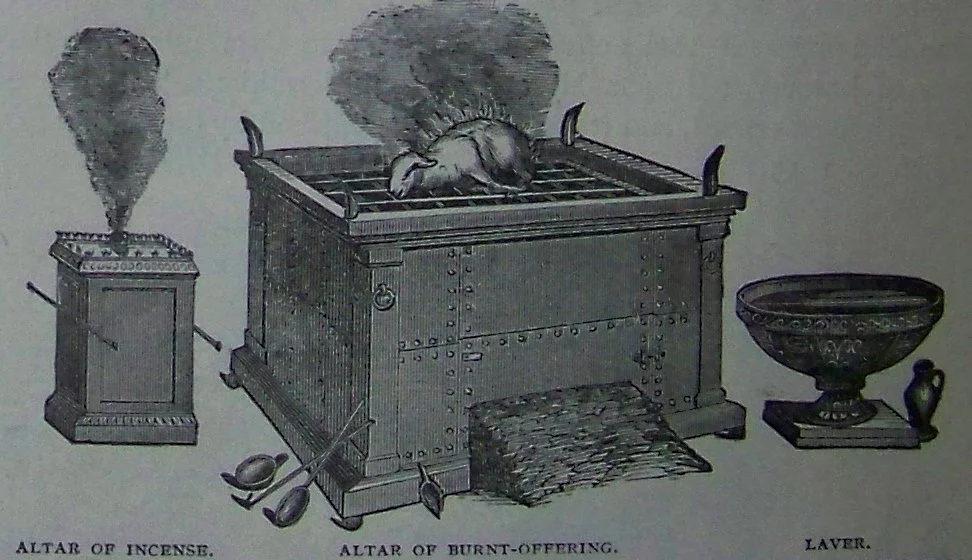
The altar of incense to the left, the altar of burnt offering is center, and the laver is to the right. Image from The Holman BIble, 1890.
The Bronze Altar and the Laver
Two major objects occupied the courtyard, each playing a role in preparing worshipers to approach the Tabernacle itself.
The Bronze Altar of Burnt Offering stood near the entrance. It was the first object worshipers encountered. Here sacrifices were offered, prayers were spoken, and families placed their hands on animals as signs of devotion, repentance, or thanksgiving. The altar anchored the courtyard’s purpose.
Beyond the altar stood the laver, the basin used for priestly washing. The priests cleansed their hands and feet before entering the Tabernacle. The placement of the laver between the altar and the sanctuary created a sequence: sacrifice, cleansing, then entry.
The courtyard therefore held the movement of worship. It was a space of honesty and preparation, where the people acknowledged their need for mercy and where the priests carried out acts of service.
A Place of Gathering
The courtyard functioned as Israel’s shared worship space. Families brought offerings, priests performed duties, and the community gathered during festivals and appointed times. Though the Tabernacle tent itself remained closed to most Israelites, the courtyard belonged to the people. It was the meeting place between God’s presence and the daily life of the camp.
The size of the courtyard allowed for significant activity. Animals were brought forward, grain offerings were prepared, and people stood waiting as priests completed rites. The courtyard was not silent. It held conversation, movement, song, and prayer.
In the wilderness, this enclosed space served as Israel’s religious center. When the camp moved, the courtyard was dismantled and set up again, reminding the people that they did not leave God behind. The sacred perimeter traveled with them.
The Symbolism of the Courtyard
The courtyard carried several layers of symbolic meaning.
Approach
The single entrance taught the people that worship involved intention. One entered by turning toward God. The enclosed space suggested that some moments deserve to be set apart.
Order
Every measurement served a purpose. The careful proportion of the courtyard reflected the ordered life God was calling Israel to embody.
Purity
The white linen surrounding the courtyard signaled cleansing and holiness. The laver reinforced this message. The courtyard became a place where outer action mirrored inner renewal.
Community
The courtyard was not a private sanctuary. It gathered the people. Worship was communal, woven into the life of the entire nation.
Presence
Though the courtyard was outside the Tabernacle itself, it marked the first step into the world where God dwelled. The people came carrying their offerings and hopes, meeting God in the open air.
The Courtyard in Later Tradition
Solomon’s Temple expanded the idea of the courtyard, creating multiple courts for priests, Israelite men, women, and Gentile worshipers. The Second Temple built a vast outer court that could hold pilgrims during festivals.
Though the scale changed, the core idea remained the same. The courtyard was a threshold. It invited worshipers to draw near and taught them how to prepare to meet God.
Christian tradition sometimes reads the courtyard as a pattern for faith: a place of confession and cleansing, leading to deeper communion. The imagery does not replace the original meaning. It recognizes that the courtyard continues to speak about approach, reverence, and belonging.
