How Tall Was the Temple?
Quick Summary
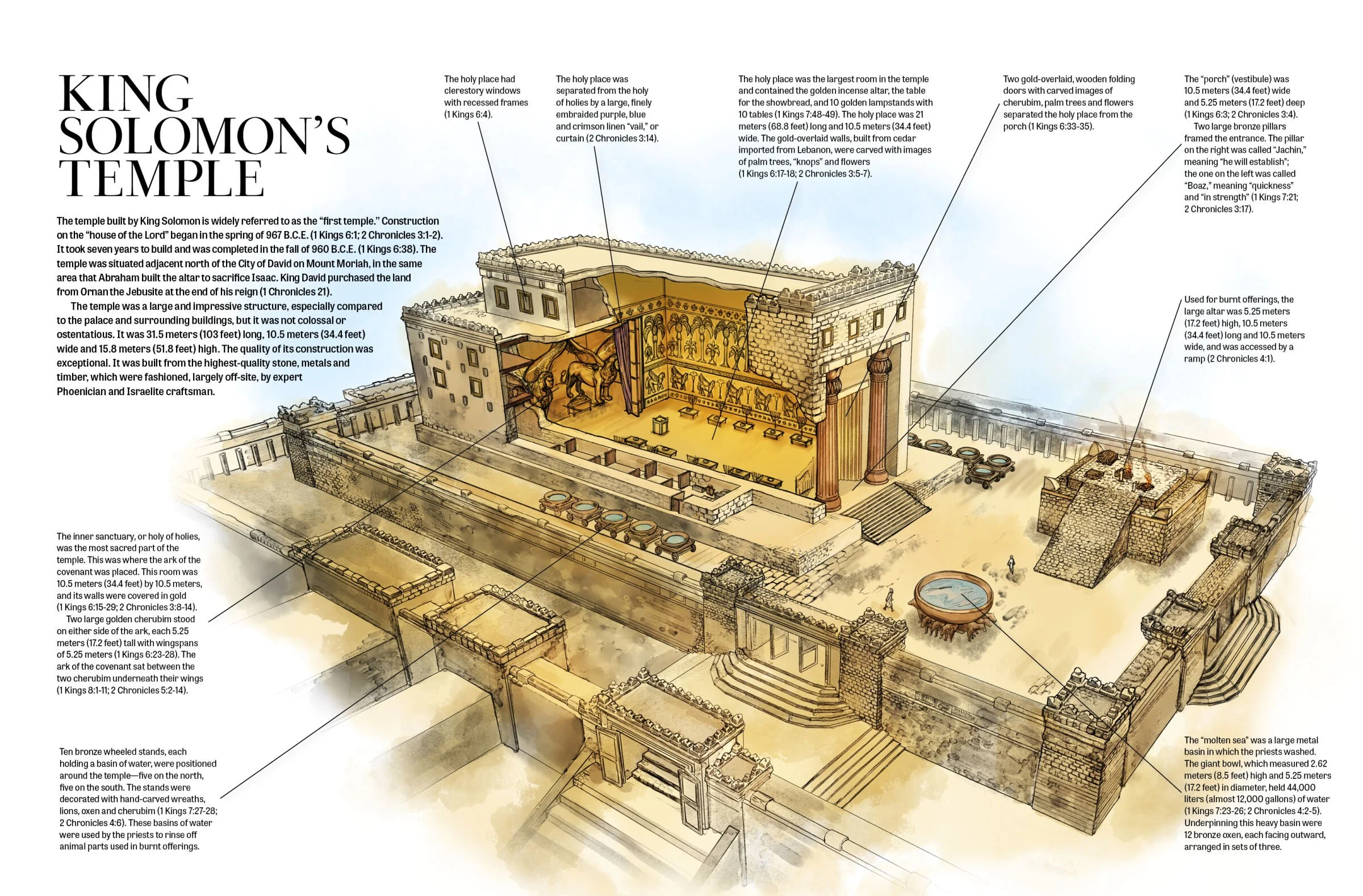
According to 1 Kings 6:2, Solomon’s Temple stood 30 cubits tall, shaping a sacred space meant to reflect God’s presence and Israel’s reverence. The height played a quiet but essential role in the Temple’s design. It expressed stability, permanence, and the upward reach of worship. The Temple did not overwhelm the landscape by its size alone. Its height worked together with its length and width to form a space ordered around holiness.
Introduction
When Scripture describes the Temple, it does so with the same steady precision found in the instructions for the Tabernacle. The measurements unfold slowly, as if the text knows that space shapes faith. Solomon’s Temple became the physical center of Israel’s worship, the place where sacrifice, prayer, and festival life all rose like steady breath.
One detail sits right at the beginning of the description: the Temple’s height. Thirty cubits. It is a simple measure, yet it tells a story. The height of the Temple was not just an architectural decision. It framed how people encountered the holy, standing as a quiet sign of God’s nearness and sovereignty.
Understanding the height of the Temple helps place the building back into its original world. It allows modern readers to see not only the structure but the meaning that held it together.
The Height of the Temple
First Kings 6:2 records the dimensions of the Temple:
Sixty cubits long
Twenty cubits wide
Thirty cubits high
If a cubit is taken at roughly eighteen inches, the Temple rose about forty-five feet. This means it was approximately the height of a four-story building. It was not towering compared to the monumental structures of other ancient cultures. Yet in the life of Israel, it stood unmatched.
The height gave the Temple a sense of upward movement without overwhelming the worshiper. It invited awe but left room for approach. It was a building meant for people to enter, not observe from a distance.
Try the Biblical Measurement Converter Tool!
The Relationship Between Height and Space
The Temple’s inner rooms followed a pattern already seen in the Tabernacle. The main hall, sometimes called the nave, led toward the Most Holy Place. The height shaped these rooms in subtle ways.
The inner sanctuary, the Most Holy Place, measured twenty cubits in every direction. A perfect cube. This meant the full thirty-cubit height did not apply to the innermost space. The vertical lines narrowed as one moved inward, creating a sense of increasing focus. The outer height gave the building presence. The inner proportions gave it mystery.
The thirty-cubit height also allowed for the side chambers that wrapped around the Temple. These rooms rose in stages, each level a bit wider than the one below. The overall structure carried both strength and softness, as if holding the sacred with architectural care.
How the Temple’s Height Compared to Other Structures
Solomon’s Temple fit into the world of ancient Near Eastern architecture, yet it did not mimic the colossal heights of Egyptian or Mesopotamian temples. Israel’s sanctuary was defined not by scale but by covenant. Its height expressed dignity, not domination.
The thirty-cubit height set it above ordinary buildings but kept it within human view and reach. It marked the Temple as holy without turning it into a distant monument.
Later structures, such as Herod’s Temple, would rise far higher. But Solomon’s Temple was shaped by a different imagination. Its purpose was to hold God’s presence in the midst of the people.
Theological Meaning of the Temple’s Height
A Sign of God’s Nearness
The Temple’s height suggested transcendence, yet it did not remove God from the world. It marked the presence of the holy right in the life of Israel.
Ordered Worship
The proportions reflected a God who creates with care. Just as the Tabernacle had precise dimensions, the Temple’s fifty, twenty, and thirty cubits carried forward the pattern.
Stability
The height gave the building a sense of permanence. Even when destroyed and rebuilt, the memory of the Temple’s shape endured. Height became not only a measurement but a symbol of faith held through generations.
Reverence
Architectural height teaches the body how to feel. It lifts the eyes and slows the pace. In the Temple, the thirty cubits formed a space where worshipers learned humility and expectation.
Height in Later Tradition
Jewish tradition held the Temple not only as a historical building but as a way of imagining faith. Its height entered prayers, psalms, and hopes for restoration. In Christian reflection, the Temple often becomes a symbol pointing toward Christ, the meeting place between God and humanity.
Yet the physical height should not be overshadowed by its later readings. Thirty cubits still matter. They remind readers that the Temple was not an idea but a building. It stood in sunlight. It cast shadows. People walked its courts and listened to prayers echo inside its walls.
